


The full report is available for download at the bottom of the page
Highlights
Canada’s housing crisis continues to affect families, but its impact varies across the country, in part due to differences in policies among provincial and municipal governments.
To assess the performance of each province, we have created a Provincial HOMES (Housing Outcomes and Management Effectiveness Score) report card that grades each province and its largest municipality on 36 indicators across five categories.
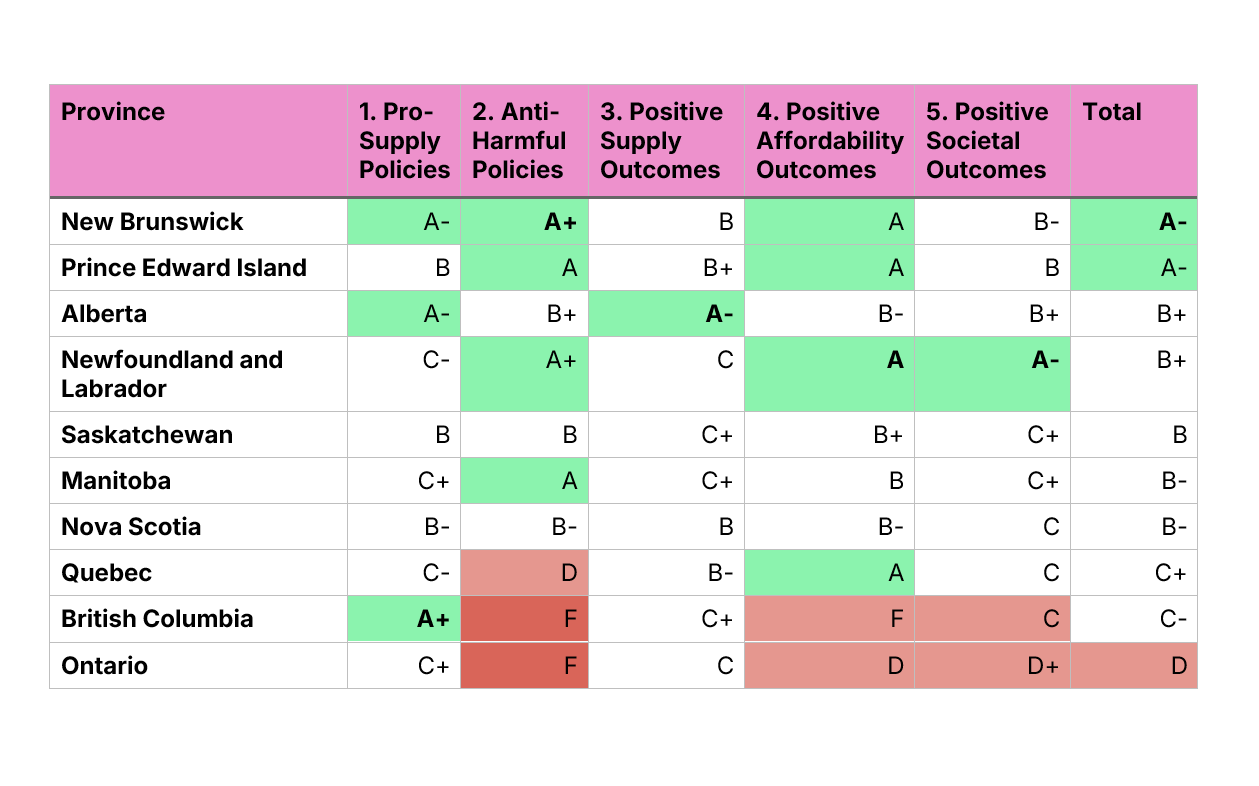
Pro-supply policies: Do governments have policies in place to accelerate housing supply, such as fast approvals, single-egress reform, and as-of-right multiplexes? British Columbia scores the highest on this index.
Anti-harmful policies: Are governments avoiding harmful or irrelevant policies, such as high development charges and other construction taxes? New Brunswick scores the highest on this index.
Positive supply outcomes: Is the housing supply increasing, and are there enough homes to house the current population? Alberta scores the highest on this index.
Positive affordability outcomes: Are homes and rents affordable relative to incomes? Newfoundland and Labrador scores highest on this index.
Positive societal outcomes: Is the province and its biggest city attracting newcomers, or are they pricing them out? Can young people move out of their parents’ homes and start their own families? Newfoundland and Labrador also scores highest on this metric.
Overall, New Brunswick is Canada’s top performer by our index, with Prince Edward Island finishing a close second. Ontario finished last, well behind 9th-place British Columbia.
The grades
About the report
Housing remains a top-of-mind issue for Canadians and is one of the federal government’s seven priorities. A December 2025 Abacus poll finds that 56% of Canadians believe that housing is among the three most important of those seven priorities, placing it second overall, behind only lowering the cost of living. Unfortunately, only 28% of Canadians believe the federal government is on track or exceeding expectations when it comes to housing.
While the federal government can and must do more, most housing policy levers rest with the provinces and municipalities. As such, those orders of government play a vital role in addressing the housing crisis. Provinces are particularly important, as, constitutionally, municipalities are “creatures of the provinces” and have whatever powers and funding tools the provinces wish to bestow upon them. As such, provinces can both directly influence housing outcomes through their own actions and by changing the frameworks under which municipalities operate.
Given the importance of provinces to Canada’s housing system, we felt that it was vital to assess their performance. To do so, we have developed the provincial HOMES (Housing Outcomes and Management Effectiveness Score) report card, which assesses the housing environment in each province across 36 indicators grouped into five categories. The indicators assess policy conditions in each province and in that province’s largest municipality. It also assesses outcomes, ranging from housing supply growth to affordability to provinces’ ability to attract and retain talent.
Our goal is to make this report card an annual tradition. For 2025, New Brunswick received the highest overall grade, an 81 (A-), with Prince Edward Island also receiving an A-. Four different provinces led categories: B.C. finished first for pro-supply policies, New Brunswick ranked highest for avoiding harmful and irrelevant policies, Alberta led in positive supply outcomes, and Newfoundland and Labrador topped the charts for positive affordability outcomes and positive societal outcomes related to housing.
This report card places particular emphasis on the human right to housing in both international and Canadian law, as reflected in the National Housing Strategy Act. Canada determines whether or not this right is being met through the metric of core housing need, which assesses whether a household has, or can reasonably obtain, housing that is not in need of major repairs (adequate), has a shelter cost ratio of less than 30% of pre-tax household income (affordable), and has enough bedrooms to house the family comfortably (suitable) and, if not, could they reasonably attain such housing. As of Census 2021, over 10% of all households experienced core housing need, meaning they could not reasonably access housing that is adequate, affordable, and comfortable.
The grading criteria in this report were designed to reflect the importance of eliminating the three components of core housing need. The overall grade assigned to each province was strongly positively correlated with a province’s core housing need score for affordability (+0.56) and suitability (+0.67), while there was almost no correlation between a province’s overall final grade and the adequacy of housing within the province (+0.05). Future reports will re-examine the choice of indicators to identify criteria more strongly associated with ensuring housing remains in good repair.
