


Highlights
Canada’s “housing as a human right” is failing in the places held up as models: CMHC data shows the GTA and Vancouver now have the highest core housing need rates in the country at over 17%, far above other metros.
Social and affordable housing is not meeting basic human rights standards: A staggering 34% of households living in social or affordable units remain in core housing need, including 59% in Halifax, indicating the system is failing the very people it’s meant to help.
Ownership remains the most stable pathway to meeting housing need: Homeowners have by far the lowest core-housing-need rate (5.5%), while over 20% of market-rate renters are in core housing need. This raises hard questions about proposals for a “post-ownership” housing future.
Many celebrated housing strategies lack evidence: Conference-favourite examples from Toronto, Vancouver, and Hamilton raise red flags: if these approaches worked, their core-housing-need rates wouldn’t be among the worst in Canada.
A true human-rights approach requires systemic change, not boutique projects: That means incomes growing faster than construction taxes; serious planning for large and multigenerational families; realistic conversations about land supply; and zoning and building-code reforms that enable family-friendly density, not just tiny homes and garden suites.
Canada can do better, but only by interrogating the assumptions behind today’s housing orthodoxy: Treating housing as a human right means ensuring every household can access adequate, affordable, and suitably sized homes in practice, not just in legislation.
Mike the skunk
I was a speaker at a conference last week in Toronto, full of well-meaning people talking about social and affordable housing. Other speakers spoke glowingly of specific projects and approaches, and initiatives happening in places like Vancouver. Some spoke about creating a post-ownership future for housing and how to create opportunities for renters.
And I was just left shaking my head. I felt as out of place as a parka in Cancun, and about as welcome as a skunk at a garden party. There were two questions I could not get out of my head:
Is there any evidence that any of these approaches actually work?
Are these approaches compatible with the concept of housing as a human right?
Recall that housing as a human right is the law in Canada, with the passage of the National Housing Strategy Act (NHSA) and is international law, through the 1966 International Covenant on Economic, Social and Cultural Rights of which Canada is a signatory.
Canada determines whether the human right to housing is being upheld through the core housing need metric. A household is considered in core housing need if one of the following three conditions are not met
Adequate housing: is reported by their residents as not requiring any major repairs.
Affordable housing: has shelter costs equal to less than 30% of total before-tax household income.
Suitable housing has enough bedrooms for the size and composition of resident households according to the National Occupancy Standard (NOS).
and the household could not reasonably access such a home, which the Parliamentary Budget Office notes is defined by a situation where the local median cost of adequate suitable housing is more than 30% of the household’s before-tax income.
If a household is in core housing need, then their human right to housing is being violated.
From time to time, Canada measures core housing need. In September 2024, the CMHC released results from the 2022 Canadian Housing Survey, including estimates of core housing need for 15 municipalities across Canada. It found that the GTA and Vancouver CMA had, by far, the highest rate of core housing need in Canada, at 17.4% and 17.3% respectively.
Importantly, it also divided the data into households that owned their homes, renters who paid market rates, and renters in social- and affordable-housing units. Homeowners by far had the lowest rate of core housing need across our 15 municipalities, with an unweighted average of 5.5%. Over 20% of renters in market-rate housing were in core housing need, and a whopping 34.1% of all renters in social and affordable housing, including 59.2% in Halifax, were experiencing core housing need, as shown by Figure 1.
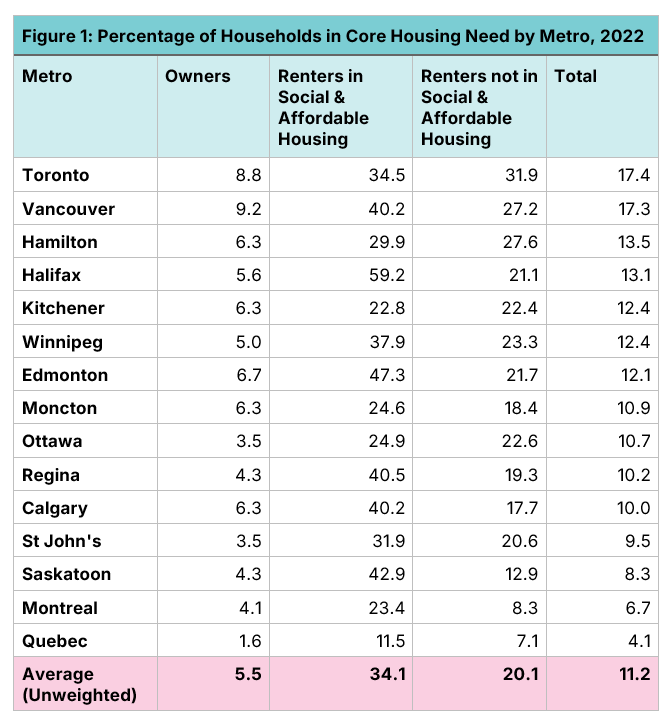
To be clear, this does not suggest that renting a market-rate home, or being in social housing, causes core housing need. Rather, composition effects are dominant, as owners, on average, have higher incomes and wealth than market-rate renters, and market-rate renters are materially better off than those in social and affordable housing.
It should, however, call into question the way social and affordable housing is built and operated in Canada. If housing is truly a human right, how can we justify that over one-third of households in social housing experience core housing need?
Similarly, we should question the logic of giving up on middle-class homeownership and creating a society in which renting is the only economically feasible option. Finally, we should question using the GTA, Metro Vancouver, and Hamilton as success stories when their core housing needs are so high.
Instead, our governments should be taking a human rights approach to housing. That starts with recognizing that we need incomes to grow faster than homebuilding costs; development charges and other construction taxes growing faster than nominal incomes are incompatible with the human right to housing. It involves recognizing that large families exist, whether they be families with many children or multi-generational families, and those families often need homes with four or more bedrooms. A focus on creating tiny homes and garden suites won’t cut it. It involves some difficult conversations about urban growth boundaries to ensure land prices do not get out of hand. And it involves substantial changes to zoning, building codes, and other regulations that prevent family-friendly density.
We need to do better as a country.