


Canada’s productivity problem has been debated for decades, yet the gap with peer countries keeps growing. Governments have tried tax cuts, trade deals, and incentive programs, but results have only gotten worse. So what is going wrong?
In this episode, Sabrina Maddeaux and Mike Moffatt break down what productivity actually means, why it matters for wages and living standards, and why the usual policy playbook has failed to deliver. They explore how red tape, risk aversion, and lack of competition are holding Canada back, and why constantly adding incentives may be part of the problem.
If we already know what drives productivity, the real question is not what more we can do. It is what we need to stop doing.
If you enjoy the show and would like to support our work, please consider subscribing to our YouTube channel. The pod is also available on various audio-only platforms, including:
Below is an AI-generated transcript of the Missing Middle podcast, lightly edited.
Sabrina Maddeaux: Canada has a productivity problem. The word productivity is thrown around a lot in economic circles, but to be clear, what it means is how much value each worker creates in a given period of time. So, if Mike and I work at a coffee shop and I serve 30 customers coffee in an hour and Mike only serves 10, I’m a lot more productive than him - 200% more productive.
Mike Moffatt: But the key idea here is that it’s the total value of outputs relative to inputs that matters. So you can increase value by increasing the number of coffees you produce in an hour. But you can also increase it by increasing the value of each coffee. So perhaps my coffees have fancy art that customers are willing to pay more for.
There are many different measures for how productive a country is, with the most basic being a simple measure of labour productivity, which takes the total annual value of everything a country produces, both goods and services, divided by the total number of hours worked across a country, and this measure is known as Real Gross Domestic Product or Real GDP per hour work.
This measure is vital because it describes the amount of wealth a country is generating each year, with that wealth then distributed to firms, workers and governments to pay for things like health care and education. So when productivity is increasing, companies are growing, new firms are created, which causes competition for workers, which drives up wages.
Overall productivity doesn’t measure how that income is distributed across society. Much of it could be going to the 1% or some other group. But generating that wealth is necessary to have high middle-class incomes and robust social programs. Even the most ardent Social Democrat realizes that a country can’t have wealth redistribution if it isn’t generating wealth.
Sabrina Maddeaux: Recently, there was a heated discussion on social media about why using GDP per capita to measure Canada’s labour productivity is an unfair metric because it doesn’t take into account things like the fact that we live longer than Americans and the United States has more inequality than Canada. We got into this debate on our recent episode on How Canada Fell behind Alabama, and we’ll link to that in the show notes.
Now, GDP per capita isn’t a perfect metric, but it’s the one everyone uses. And today I want to focus on why we have been falling so far behind for so very long. This line by Charles Lamman from a recent Globe and Mail column really struck me. He wrote, and this is a quote:
“We have known what drives productivity for decades, and we have spent those decades either ignoring the evidence, making minor adjustments, or in some cases, actively doing the opposite.” -Charles Lamman
What’s your take on that?
Mike Moffatt: Yeah, I totally agree that Canadian productivity has been falling behind for years, and that’s just a fact. Now, there is a caveat here. There are many competing definitions and measures of productivity, i.e. GDP per capita, GDP per hour worked, and a whole host of others, but they all basically say the same thing.
We’ll include a graph for our YouTube audience, but for our listeners, it compares the labour productivity of all G7 countries, plus Australia, for the period covering 1995 to 2023, and Canada is at the bottom. We’re only ahead of Japan.
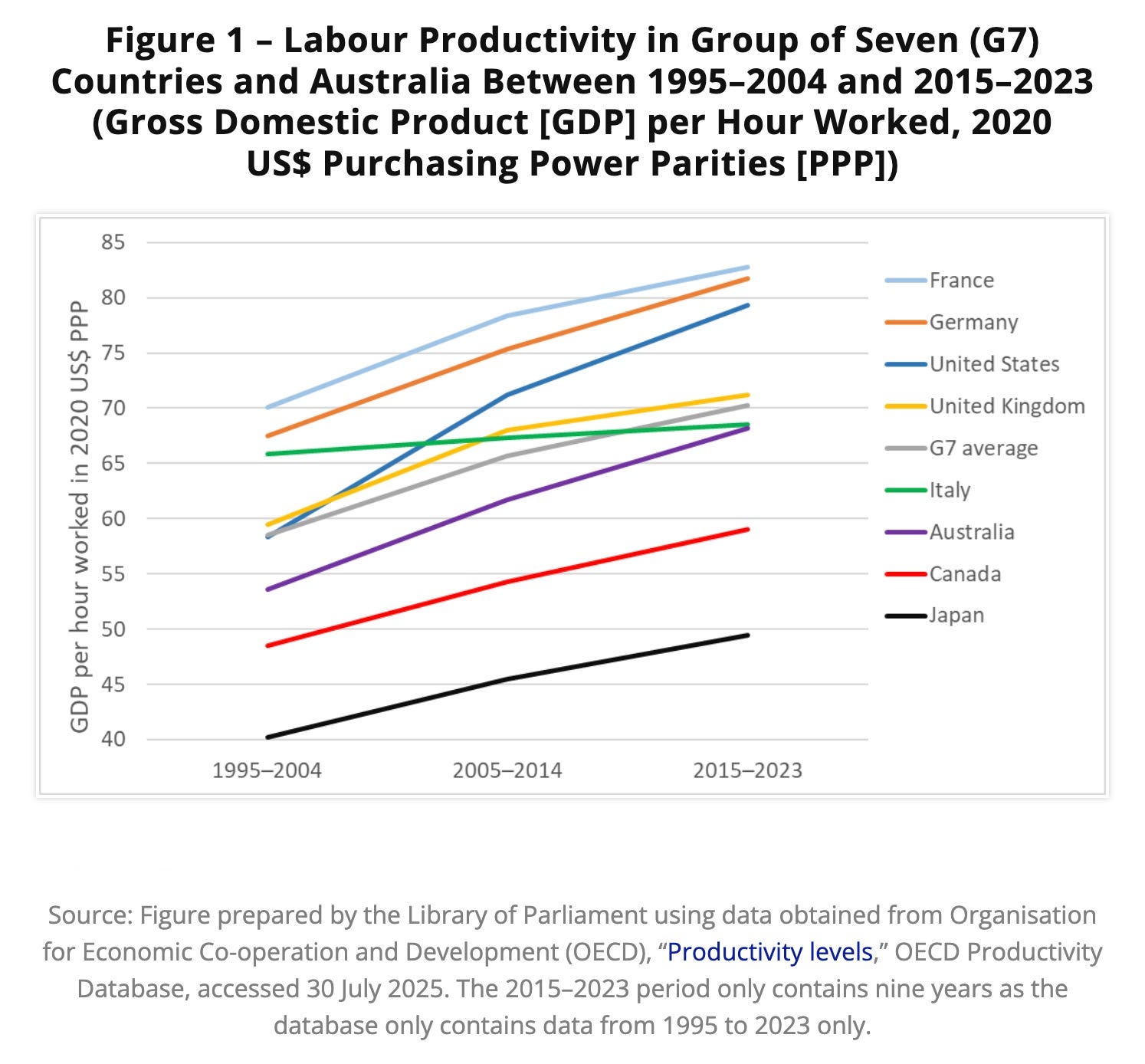
I find the media discourse on this topic incredibly frustrating, because every other day there’s some op-ed about how Canadian policymakers need to focus more on productivity without any kind of indication of what they should be doing. Like, there’s some magic productivity button in the Prime Minister’s office, and he just needs to push that button harder and bang, we’re all more productive.
Governments have been implementing pro-productivity policies for decades, so it’s not like they haven’t been trying, but rather that their efforts haven’t caused much of an improvement. And if anything, some of them may have even been counterproductive.
Sabrina Maddeaux: Like what?
Mike Moffatt: Well, back in 2011, Don Drummond wrote a well-known piece called Confessions of a Serial Productivity Researcher. We’ll link to that in the show notes. And in the piece Drummond writes:
For many years, the author believed that Canada’s weak productivity performance reflected inappropriate public policy. Despite most of the public policy agenda that was put forward to improve productivity being implemented, productivity growth in this country since 2000 has actually deteriorated.
The playbook of things that governments did included signing free trade deals like NAFTA, cutting corporate income tax rates, eliminating capital taxes, increasing depreciation rates, eliminating the deficit (at least temporarily), reducing government debt (at least temporarily), introducing inflation targeting, and so on. And while these policies impacted the Canadian economy and society, for both good and bad, our productivity performance actually got worse.
Sabrina Maddeaux: Now that’s a long list, but there is a notable omission from your list, and that’s cutting red tape. There’s too much of it. And as part of that, too much deference to special interest groups that often block development and projects going forward, which could increase our productivity.
And as we’ve mentioned many times on this podcast, Canada is an incredibly difficult place to get anything built, from housing to pipelines to high-speed rail, which ultimately harms our productivity. The ability of people to live close to where they work and travel efficiently within a country, or switch jobs, increases worker productivity. And although these things do get discussed in headlines and policy circles, nothing seems to change.
Mike Moffatt: Yeah, that’s exactly it. And I think Canadian governments have been asking the wrong questions entirely for the past 40 years. They always ask: What could we do to increase productivity? And they wind up with ideas like worker training initiatives or lending programs for small businesses, or shiny new tax provisions. And to be clear, some of those are actually really decent ideas. So we should consider them, but governments never seem to ask the question: What could we stop doing to increase productivity?
And I think that second question is more important because…
In my view, there are two reasons why corporate leaders do anything: greed and fear. And governments rely too much on greed and creating incentives, and I think not enough on fear. Every time corporate Canada runs into trouble, governments are there to save the day.
Are there tough times in an industry? We’ll have a bailout package. Is it getting hard to find labour? Let’s add more temporary foreign workers. Are you getting undercut by foreign competition? Let’s put up trade barriers, let’s introduce a supply management system and so on.
But it’s actually fear that tends to drive productivity and innovation, not incentives.
If you want to see a big jump in productivity and innovation, look to Ukraine. They have no choice but to become more productive, to find creative solutions to labour shortages, to find ways to integrate disabled workers and older workers into the labour force, as they’re facing an existential threat.
Now, to be clear, I’m not suggesting Canada start a war with a larger opponent, but I do think that there are lessons there. That instead of trying to incentivize companies to innovate, we should be opening them up to foreign competition. We should knock it off with all these temporary foreign worker schemes, and instead have governments focus on making a regulatory system that works better. Addressing the issues at the CRA, which you’ve written about a lot, so businesses can focus on their business rather than navigating semi-functional government programs and processes.
Sabrina Maddeaux: You’re so right. And you hear in a lot of conservative circles, especially in the States, that welfare for individual workers is bad for productivity. I’ll say corporate welfare is very bad for productivity because it says you’re too big to fail. There’s no actual risk. So why actually invest in innovation or your workers or make changes, be bold? Those sorts of things that actually lead to better productivity.
And this all gets to the idea that incentives can’t force companies to invest in increasing productivity; just lowering corporate taxes or depreciation rates can create the conditions for companies to reinvest, but they can also just increase after-tax profits, which they then distribute back to shareholders through increased dividends and share buybacks.
That point about temporary foreign workers is so important. Why invest in new technology to become more productive or upskill your workers when you can simply throw more inexpensive labour at the problem? Companies are most likely to make these investments when workers are scarce. But by law, as soon as the unemployment rate falls under 6% in a city, companies are given much easier access to foreign workers. And we’re seeing that right now across Canada. It’s maddening.
Governments keep saying that they want more productivity, but the second companies start to feel the pressure to make those investments, governments panic, step in and ensure they don’t have to.
How do we actually fix this?
Mike Moffatt: Well, as you say, it all comes down to competition and creating a regulatory environment that allows companies to build things and make investments. And then when it comes to investments in productivity, fear is a better motivator than greed. And I think that Canada’s business culture also needs to change, and increased competition can help with that.
For over a decade, I worked as a regulatory consultant in the chemical industry, mostly in consumer products. I spent a lot of time speaking at conferences, working with clients, and working with a lot of companies that produced aerosol products. So everything from brake cleaners, for a car, to hair spray. And anyone who’s ever worked in the consumer packaged goods industry knows that it is almost impossible for a small Canadian manufacturer to get their products on retail shelves in this country.
I used to advise my clients that the fastest way to sell 10,000 units to one of the big Canadian pharmacy chains - which I won’t mention by name because I like not being sued - is to sell 100,000 units to an American chain like Walgreens or CVS first. Because big Canadian retailers won’t buy from small Canadian companies until they’ve proven themselves in the U.S. first, because there’s a massive amount of risk aversion up here that you don’t see in the U.S.
One of the nicest compliments I ever received was in South Carolina. I was having dinner with a number of VP’s from a company headquartered in the South. We were discussing expanding a deal we had finalized a few months earlier, when that company had switched from one of our Canadian competitors to working with us. And the thing they told me, which really warmed my heart, was that ‘We like working with you, rather than them, because you think like a Texan.’ It was cliché, but I think he genuinely meant it.
There is a real aversion in Canada to trying new things, to taking risks and to thinking big.
That’s my take, I’d love to get yours.
Sabrina Maddeaux:
Canada absolutely has a risk aversion problem. I saw similar things when I started my career in fashion and lifestyle journalism. I worked with a lot of young and up-and-coming Canadian designers, and they experienced similar problems where the large Canadian retailers wouldn’t put them on shelves or make big investments in them until they had already made it outside of the country. So you saw a lot of that talent leave or exit the industry altogether.
And we’re seeing that pattern repeated across many industries.
Certainly, fear needs to come back into the reality of doing business in Canada, not in a negative way, but in a way that inspires people to take risks that they otherwise feel very comfortable, too comfortable not taking.
Thank you so much, everyone, for watching and listening. And to our producer, Meredith Martin and our editor, Sean Foreman.
Mike Moffatt: If you have any thoughts or questions about how to get beauty products onto store shelves, please send us an email to the [email protected].
Sabrina Maddeaux: And we’ll see you next time.
Additional Reading/Listening that Helped Inform the Episode:
StatCan: Labour Productivity and Related Measures
The Globe And Mail: Productivity is an urgent problem for Canada. The response? A 15-year study
Confessions of a Serial Productivity Researcher
Canada: Q4 Productivity Slips Under the Weight of Tariffs and Uncertainty
From Bad to Worse: Canada’s Productivity Slowdown is Everyone’s Problem
The Globe And Mail: Eighteen ideas on how to kickstart the Canadian economy
What Is Canada’s Productivity Performance and How Does It Compare to Other Countries?
Towards An Inclusive Innovative Canada
The Secret to Ukraine’s Remarkably Resilient Labour Market
Out of Nowhere: How Canada Fell Behind Alabama
Funded by the Neptis Foundation
Brought to you by the Missing Middle Initiative
With France at the top of chart for productivity (famous for worker friendly and bureaucracy), I be curious to hear more about what other countries are doing right, to contrast with what Canada is supposedly doing wrong
“Now that’s a long list, but there is a notable omission from your list, and that’s cutting red tape.”
And it’s glaringly missing. Great point.