


Highlights
Today, MMI, in conjunction with the Cornerstone Association of REALTORS, released the report, From Cornerstone to Capstone, which provides 15 practical recommendations on how governments can increase the supply of gentle-density housing. The report can be downloaded at the bottom of the page.
The price of new homes, while down from pre-pandemic peaks, is still out of reach of many potential homebuyers.
Communities are falling behind their housing supply targets and need a wide range of housing options to support a diversity of needs at an attainable price.
Gentle density housing, including multiplexes, accessory dwellings, and laneway homes, can create housing options in both new and existing neighbourhoods while maintaining the neighbourhood’s look and feel, as buildings are limited to a maximum of 3-4 storeys and 600 m².
There are five barriers, in particular, that limit the construction of gentle-density housing: Zoning and approval processes, a lack of regulatory harmonization between municipalities, high development charges, fees, and taxes, and barriers in obtaining construction financing and obtaining sufficient electricity amperage
As well, current regulatory structures make it cost-prohibitive, and in some cases, outright impossible, to have families purchase the gentle-density home that they occupy, limiting the use of gentle-density to rental.
Experiences in other jurisdictions, such as British Columbia and Oregon, show that these challenges can be overcome.
There is a role for municipal governments, along with provincial and federal governments, in creating the conditions to enable attainable, gentle-density homes to be built in new and existing neighbourhoods.
Unlocking gentle-density
Ontario needs more homes to accommodate a variety of family types, and housing remains a top-of-mind concern for Ontarians. Although rents and home prices have eased in many markets in recent years, affordability remains a challenge. Young people, and couples, in particularly struggle to find an attainable home that suits their needs. Twenty years ago, a couple in their late-20s or early-30s could find a newly constructed family-sized starter home for four times their income. Today, it requires nearly twice that, making qualifying for a mortgage a near impossibility.
The lack of attainability has not reduced young people’s desire to own a home, as a recent OREA poll finds that 88% of non-homeowners under the age of 30 in Ontario desire to own a home one day. Unfortunately, there is a shortage of homes that suit their needs at a price they can afford. A lack of supply diversity not only affects the young; seniors currently lack downsizing options that meet their needs in the neighbourhoods they wish to live in.
High land prices, the need for municipalities to use infrastructure efficiently, and the need to create housing options in existing neighbourhoods have led to a demand for gentle-density housing. Gentle-density housing refers to housing options that blend into existing low-rise neighbourhoods while allowing higher unit density than traditional single-detached and multi-detached homes. These include, but are not limited to, stacked townhouses, multiplexes, and accessory dwelling units.
Gentle Density Housing Types
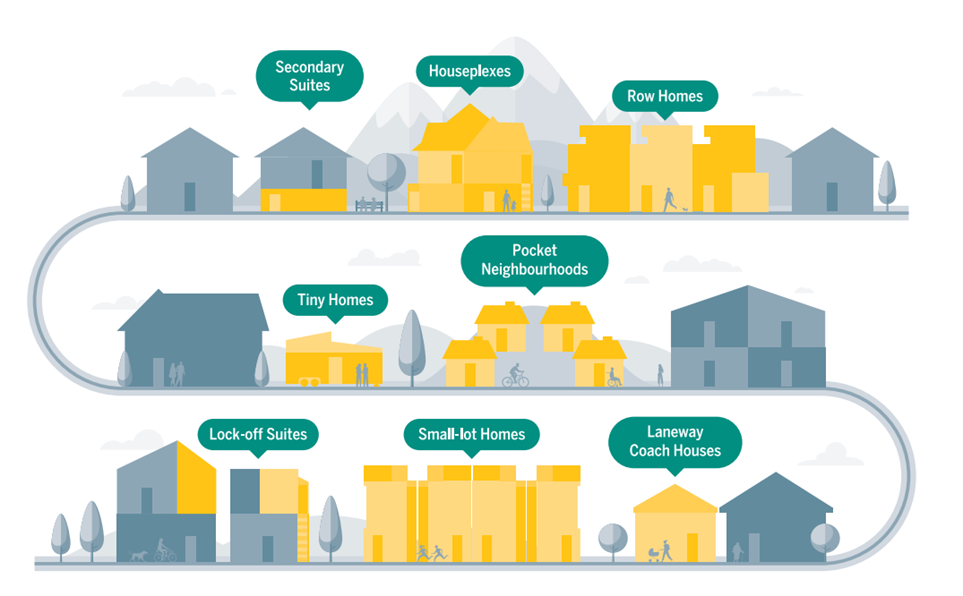
Chart Source: Gentle Density Toolbox
While there is a need for these types of homes, building them in a way that suits the needs of a diverse range of families at a price they can afford is a formidable task. While not an exhaustive list, MMI has identified five barriers as being particularly challenging:
Zoning and approvals processes that outright prohibit, or increase the risk and cost, of building gentle-density housing.
A lack of regulatory harmonization across municipalities, which limits economies of scale and the use of modern methods of construction.
Development charges, fees, and taxes, which make building new gentle-density housing cost-prohibitive.
Barriers to obtaining construction financing for gentle-density housing.
Utilities making it difficult, time-consuming or expensive to obtain sufficient electrical amperage, particularly for lots with EV charging or homes with electric heat pumps.
A final barrier is the lack of regulatory structures that allow individual units to be owned by their occupant. While this does not prevent homes from being built, it does limit housing options for those who wish to own their own homes.
These barriers can be overcome with smart public policy, but for existing neighbourhoods in particular, they must be implemented in ways that take into account the needs of existing residents, many of whom are concerned about the potential downsides of densification.
Recommendations
Increasing the availability of attainable gentle-density housing won’t just happen; it will require a series of policy reforms. It will require tackling the five largest bottlenecks to building gentle-density housing. Additionally, to ensure that gentle density works for all family types, reforms are needed to allow occupants to purchase gentle-density units rather than just rent them.
These challenges must be addressed in a way that is sensitive to local concerns, while also respecting Canada’s division of powers. The tools needed are split across multiple orders of government. To break down these barriers, we have provided a list of 15 recommendations, split evenly across three orders of government.
Municipal recommendations
Recommendation 1: Institute a series of zoning reforms to gradually transition to full form-based zoning for both existing and new low-rise neighbourhoods.
Recommendation 2: Reduce or eliminate minimum parking requirements to facilitate the creation of additional units on existing lots.
Recommendation 3: Create forgivable loan or grant programs for the construction of Accessory Dwelling Units (ADUs).
Recommendation 4: Reform development charges to facilitate the creation of gentle density.
Recommendation 5: Work with local utility providers and electricity distribution companies (LDCs) to ensure that gentle-density projects can easily and inexpensively access necessary infrastructure, including appropriate levels of electricity, water, and wastewater services, and to adopt measures similar to Toronto Hydro’s Multiplex PowerPlay pilot.
Provincial recommendations
Recommendation 6: Harmonize rules and remove barriers to gentle-density housing by instituting a series of zoning reforms to gradually transition to full form-based zoning for both existing and new low-rise neighbourhoods, and by amending the building code.
Recommendation 7: Follow the lead of jurisdictions such as British Columbia and Oregon to create simple pathways to allow individual, low-density housing units to be owned by their occupants.
Recommendation 8: Reform development charges to provide financial relief for new development, including exempting development charges from PST and land-transfer taxes.
Recommendation 9: Follow the lead of British Columbia and provide a full exemption on the land-transfer tax for newly constructed homes valued under $1.1 million.
Recommendation 10: Extend the enhanced HST rebate on new owner-occupied housing beyond one year.
Federal recommendations
Recommendation 11: Create construction financing vehicles for gentle-density housing.
Recommendation 12: Increase the number of gentle-density options in the CMHC Housing Design Catalogue.
Recommendation 13: Implement the 2025 campaign promise to reintroduce the MURB program and ensure it is designed in such a way that it can be used to create gentle-density housing.
Recommendation 14: Tie future federal housing and infrastructure funding to provinces and municipalities to the adoption of pro-gentle density housing reforms.
Recommendation 15: Reform the GST to lower the cost of housing construction, including exempting development charges from GST and extend the enhanced HST rebate on new owner-occupied housing beyond one year.
Download the full report below:

Having built a 4 Plex infill in Toronto the work involved is far too onerous for any realistic return.
Ownership is currently limited to creating a condominium which is very expensive and time consuming.maybe 8 units might be worth the trouble.
From Four Pillars Community Housing: this is exactly the kind of clear, practical thinking Canada needs right now. Gentle density is not a theory problem anymore, it is an execution problem.
When zoning, approvals, financing, utilities, and ownership pathways all work against small-scale housing, we should not be surprised when communities fall behind. What Mike lays out so well is that ADUs, multiplexes, and other gentle-density forms can fit existing neighbourhoods and create more attainable housing options, but only if policy finally matches reality.
We strongly support this call for smarter reform, better alignment across governments, and real tools that help families and communities benefit from more housing choices. More talk is nice. Fewer bottlenecks is nicer.