


Development charges are a $66 cup of coffee
Development charges (DCs) in Ontario have skyrocketed over the past two decades, from being a relatively minor expense to adding over $100,000 to the cost of a middle-class family home. For example, over the last 25 years, DC fees on single-detached homes have increased by 5,186 percent in the City of Toronto, compared to a 72.1 percent inflation rate during this period. If prices for consumer goods had risen by the same rate as DC fees, then a cup of coffee costing $1.25 in 2000 would cost $66 in 2025, and a family purchasing a sedan for $24,000 would have to pay nearly $1.3 million today.
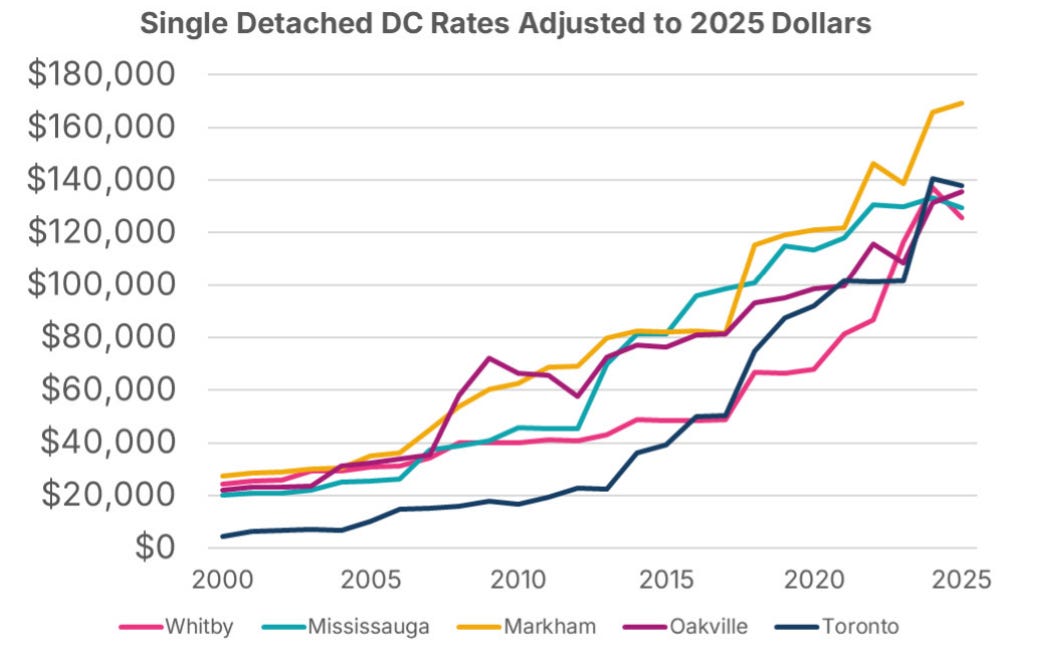
This problem requires practical solutions that don’t involve simply transferring the cost of infrastructure on to the property tax base.
Earlier today the Ontario Real Estate Association released the report A Pathway to Development Charge Reform, providing seven practical recommendations on how Ontario can lower development charges in a prudent, fiscally responsible way. MMI’s Mike Moffatt and Alex Beheshti are co-authors of the report.
The seven recommendations in OREA’s roadmap to reducing devleopment charges are as follows:
Seven ways to reduce development charges
Provide immediate relief to homebuyers and accelerate housing construction through a two-year DC suspension program.
Lower tax bills and interest costs by reducing infrastructure construction costs through alternative financing mechanisms, such as municipal service corporations and municipal utility districts.
Substantially lower the price of new homes by removing tens of thousands of dollars in interest costs and tax-on-tax by implementing a transparent direct-to-buyer DC billing model that exempts DCs from Harmonized Sales Tax (HST) and Land Transfer Tax (LTT).
Lower the price of new homes by removing population growth-related costs from DCs.
Remove community-wide services, such as long-term care, public health and emergency services, from DC eligibility.
Create a performance-based funding model based on population growth.
Reduce DCs and eliminate waste in the system by increasing transparency and standardizing methodologies across municipalities.
Eliminate non-committed, aspirational, or unfunded wishlist projects from DC background studies.
Prevent hidden DC escalation by ending automatic indexing and requiring council votes on rate changes.
Standardize key assumptions to reduce disputes and improve fairness.
Reduce cost pressures on municipalities by improving coordination of infrastructure planning, including transit and roads, between all levels of government.
Improve accountability and public trust by increasing transparency and reporting of DCs.
Enhance transparency standards through uniform reporting and disclosure.
Establish independent oversight through a DC Inspector’s Office.
The full report can be found on OREA’s website.
Please keep up the great and important work you're doing!
That must be a pretty good cup of coffee! Thanks for writing, Mike. Can you help me understand the second bullet under #4?