


“If you work hard, you’ll get ahead.”
It’s a foundational promise of the Canadian identity. But as Cara Stern and Mike Moffatt discuss in today’s segment, that promise is starting to feel like a relic of the past.
Drawing on new data from Ipsos and Statistics Canada, this conversation tackles the growing “fairness gap” between generations. While over half of Boomers still view Canada as a pure meritocracy, only a third of Gen Z feels the same. The data backs up the cynicism: intergenerational social mobility is trending downward, and for the first time in decades, the “bottom 20%” is becoming a permanent trap.
So is Canada still a meritocracy? The answer may not be a simple yes or no. But it is clear that the country is moving in a direction that raises serious questions about fairness, opportunity, and what it really takes to get ahead.
If you enjoy the show and would like to support our work, please consider subscribing to our YouTube channel. The pod is also available on various audio-only platforms, including:
Below is an AI-generated transcript of the Missing Middle podcast, lightly edited.
Cara Stern: People like to think if you work hard, you can get ahead. But we’ve all worked in offices and seen someone who maybe doesn’t deserve it get promoted. Maybe they’re close with the boss, or they’re good at schmoozing with the hiring managers, or they’re tall and funny, but they aren’t actually the most qualified. And it’s a reminder that success isn’t entirely based on how hard you work. Which leads me to today’s question: how would you define the word meritocracy?
Mike Moffatt: Well, first of all, I think being tall and funny is a qualification. But that aside, meritocracy is the idea that the rewards in society — money, power, status, vintage baseball cards — should go to the most talented and hardest working people. Not the ones born with the biggest trust funds or the best connections.
Cara Stern: Yep, that definition works for me. So the next question is a bit harder. Is Canada a meritocracy?
Mike Moffatt: Yeah, this question frustrates me a little because my response is like, compared to what? Compared to France? The NBA? A ham sandwich? It reminds me a little bit of the recent debate about whether or not Canada is broken. It just creates this false binary with an unclear dividing line between is and isn’t broken or is and isn’t a meritocracy. So I find that the answer to that question tends to say more about the person answering it than anything else. But this is where the relative part comes in.
I think Canada isn’t nearly as much of a meritocracy as it could or should be. I think it’s less of one than it was, say, 15 or 20 years ago.
So even though I dislike the question, it does seem fair if I ask you the same question, unedited. So, do you think Canada is a meritocracy?
Cara Stern: I think it sort of is. Canadians, broadly speaking, like the idea that you can be born here, that you can come here as a refugee. You can grow up with very little material wealth and then become rich or middle-class through hard work. But I’m actually a little bit skeptical if that’s true, and I think it may have been true in the past, but I’m just not sure if it’s true anymore.
And like I said earlier, we’ve all had experiences at work or in our professional lives where we try really hard, we do everything right, and we see other people who didn’t do everything right, didn’t try as hard, get farther ahead. And every time those experiences happen, they undermine in a real, tangible way that Canada is a meritocracy. But I think at a gut level, people understand that maybe it isn’t fully a meritocracy.
Mike Moffatt: Yeah, I think that’s an important distinction because there are different ways of measuring it. So one way is you could look at income data. You could look at how much someone’s income is correlated with that of their parents, or if there are differences between someone’s income based on where they grew up, like their postal code. Differences can’t be explained by other factors.
But qualitative research can also be quite helpful where the researcher focuses on understanding, interpreting, and analyzing personal experiences, feelings, beliefs, and perspectives of either individuals or groups of individuals. I also think polling data, which is both qualitative and quantitative, can be incredibly helpful for a subject like this to determine how the population feels as a whole. And as well are there any differences in averages and beliefs among groups on whether or not they believe Canada is more or less fair or meritocratic?
Cara Stern: So I’ve been thinking about this because I went to an Ipsos event recently and they presented some material, and what they suggested was that Canadians are actually quite divided when it comes to perceptions of fairness, success and hard work, and whether that pays off. The number one thing that impacts your perception of whether or not hard work equals success is the generation you were born into.
Ipsos surveyed over 20,000 people under 75 years old from 31 countries, and they asked:
In your country, what do people’s chances of success depend on?
They gave two options. A) People’s chances of success in their country depend mostly on their own merit and efforts.
Or B) people’s chances of success in your country depend mostly on factors beyond their control.
In Canada, more than half of boomers think that, yes, it is mostly about merit, while Millennials and Gen Z are both around a third.
Mike Moffatt: Okay, so I’m sitting here in my flannel and my Nirvana t-shirt, and I’ll note you still excluded Gen X from your analysis, but that’s fine. We’re used to it. We’re the forgotten generation. I’ll go drink water out of a garden hose, whatever, and just sit here being ignored.
But if we go back to your numbers, you said that there was about an 18-point difference, with boomers more likely to answer A, and that the results are mostly about merit and effort. So what about the responses to B?
Cara Stern: Well, only 19% of Boomers said that success depends mostly on factors beyond their control. And Millennials and Gen Z came in at 28 and 35%. And Gen X, fine, I will get some data for you guys. You guys are in the middle of Boomers and Millennials in age, but you’re also in the middle in sentiment, as usual.
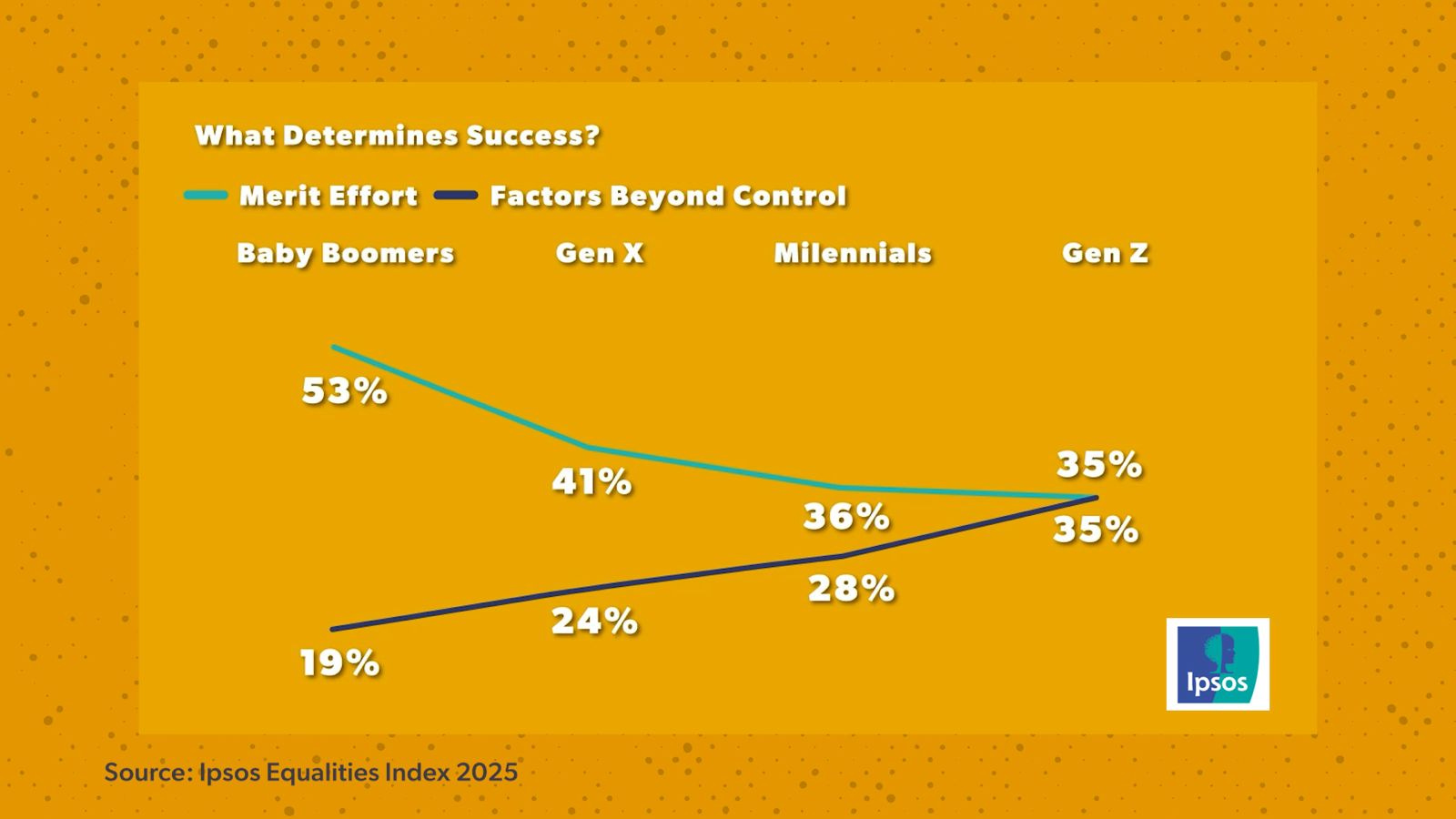
Mike Moffatt: Well, we are the missing middle generation. But overall, I think it’s interesting that more people said results were primarily based on merit and effort rather than factors beyond their control. So that is a sign that overall Canadians lean towards thinking that we’re more of a meritocracy rather than one where your success depends on your circumstances of birth.
And for Boomers, it was interesting to note that it was heavily tilted towards meritocracy, with your category A merits getting chosen almost three times as much as category B, factors outside of your control. But for Gen Z, the results were split roughly equally between A, B, and not sure. So it’s a really interesting generational divide.
Cara Stern: The other place where there’s this clear generational divide is on the question of fairness. I found this really interesting. They asked whether equal outcomes or equal opportunities define a fair society. Boomers were more likely to say opportunity is more important, and Gen Z were much more likely to say equal outcomes are more important. I’ve always heard that defended as: if outcomes are unequal, that tells us that something’s not equal about the opportunities, even if they seem fair on the surface. And Gen X gets a mention here, too. You guys are more like Gen Z than Boomers in this regard.
Mike Moffatt: Well, that’s really nice to hear. I think these results make a lot of sense when you think about it.
Think about young people who were all told growing up: work hard in school, get a great education, and the world would be yours. They did all of that. They did everything right. Everything that they were told would lead to homeownership and a white picket fence and 2.3 children and all of that. Yet now they’re finding they’re struggling to find work. They’re struggling to pay the rent.
They’re thinking like, hey, this situation isn’t fair because we’re dictating or believing that fairness is defined by the same quality of life. And those people are having such a difficult time achieving those milestones that every other generation seems to acquire more easily.
Cara Stern: So I’ve given you lots of information from the pollsters. What do economists say about this?
Mike Moffatt: Well, economists have a lot of different ways of looking at this, but one of the best measures, or one of my favourite measures we have as a proxy for meritocracy, is a correlation between your income and that of your parents. And as I mentioned earlier, that is one of the best measures, because in no way can a society be considered meritocratic if your success in life is largely determined by who your parents are.
There’s a Statistics Canada research study — we’ll link to it in the show notes — that shows over time people’s incomes are becoming more correlated with that of their parents, which suggests Canada is becoming less meritocratic and more unequal over time, and that social mobility is eroding.
Cara Stern: So it’s getting harder and harder to move up the income ladder.
Mike Moffatt: Yeah, absolutely. At least in an intergenerational sense, that in Canada, kids who grow up in the bottom 20% of family incomes are now more likely to stay there as adults. It used to be that about a quarter of kids who grew up in the bottom 20% stayed there as adults. Now it’s closer to a third. So to be clear, a lot do move, but you’re getting more stuck in the bottom 20% than you used to get.
Cara Stern: A full third of kids can’t get out of the bottom 20%, and we know it’s trending in the direction of getting harder and harder still.
Mike Moffatt: Yeah, exactly. Yeah. And because of that, fewer of them end up in the middle class, which in their report is defined by being outside the top 20% in the bottom 20%. So overall, it’s gotten a bit harder for kids born in low-income families to move up and a bit more likely that they’ll stay where they started.
Cara Stern: So essentially, your ability to have a middle-class income is more of a function of who your parents are than it used to be.
Mike Moffatt: Yeah, absolutely. And what do we think is going to happen when an older cohort of people believes that they live in a meritocracy, but younger people listen to that, they hear their parents and their grandparents, and it really doesn’t match the lived experience of younger generations. How are they going to respond to that?
Cara Stern: Yeah, so much frustration and increasingly we see a lot more distrust in institutions and politicians. And just in the idea that if you play by the rules, you’re going to get somewhere.
So a lot of people just get to the point where they’re just like, why bother? And that’s a big problem for society. Imagine you’re doing everything right. You’re working super hard, you’re not getting ahead, and you’re being told it’s your own fault by people who play by totally different rules.
Mike, I’m sorry to say you’re much closer to the boomer age than I am, so I’m hoping you can channel their minds for a moment. Can you bring out your “Uncle Boomer Mike”? How do you actually change minds on this when people’s sense of whether Canada is fair is wrapped up in their own life story?
Mike Moffatt: Well, I think it’s really important to hear the stories of younger generations because absolutely, we tend to view the world through the lens of our own experiences, how we grew up. So in the mid-1990s, I’m going to go back to my childhood in London, Ontario. A lot of us at the time didn’t necessarily see the opportunities in London for us. So a lot of my graduating high school class and a lot of my university class ended up going to Toronto or Vancouver to get those jobs. There were sacrifices there. We had to leave our families to do that, and that was a challenge. And certainly, we don’t like to be told we had it easy or things were fair, but I think a lot of my generation and older don’t realize that that pathway has been closed for a lot of younger people.
If you are growing up in Whalen Corners, Ontario, you’re probably not going to be able to move and take that entry-level job in Toronto that doesn’t necessarily pay well, but can be the first step on climbing the corporate ladder. You just can’t do that because you can’t afford to live in the city. So I think it’s important that these stories get told.
And I think it’s important for older people like me to understand that the world has changed, the country has changed, and what worked for us 25 or 30 years ago doesn’t necessarily work today.
Cara Stern: What I hear you saying there is that housing is expensive in Toronto. It’s hard to be able to move to these places or wherever you can go to find jobs. So what I start thinking is, maybe if we just solve housing, that would go a long way to fix this, no?
Mike Moffatt: I’m absolutely a fan of the housing theory of everything, but I don’t want to suggest that that’s causing all of this. But it is causing a portion of it, and if we do solve the housing crisis, particularly in our cities, I think that would help with social mobility a lot.
And, we often hear from people my age and older who say, “Well, if you can’t afford to live in Toronto, there are lots of great places in Canada, just go move somewhere else.” I don’t think they realize what that does to social mobility. I don’t think they realize how that creates, again, a situation where your success in life is determined by who your parents are. And that’s not going to lead us to a great place where you’ve got all of these young kids who figure out, like, hey, they’re never going to be able to achieve certain levels of success simply because of the circumstances of their birth.
I’m not going to suggest that we’re going to French Revolution styles of disorder, but I can’t think of a society where that ended well for anyone. So, hopefully, we can fix the housing crisis. We can get people to acknowledge that it is important for young people to be able to move to the city or the neighbourhood of their choice.
Cara Stern: I feel like it’s hard for people to accept what you’re saying, because when you say it to them, especially if they worked hard and did very well, that part of it is that the rules are in your favour. That makes people feel a little bit like you’re taking something away from them. They worked hard and they want to know that that is something that they earned, and it is something they earned. But the rules have changed. How do you get people to listen to this and stop taking it as a personal attack on whether or not they worked hard enough?
Mike Moffatt: Well, I think we have to try and get people to understand that you have to have the preconditions of success.
So yes, you got to where you are because of your hard work and talent just the same way that Bill Gates and Steve Jobs and all of these folks absolutely built all these incredible companies and this great wealth, but they wouldn’t have been able to do it if they lived in 14th-century Scotland, right? You have to understand that it requires both effort and environment.
And, I think we also just have to realize that some people are just going to be selfish or not particularly concerned about the welfare of others. So I think we also have to recognize we’re not going to get through to everyone, but I think we can get through to enough people out there. I think there are enough reasonable people to say: we’re not denigrating your effort. We’re just recognizing that success is a function of both effort and environment, and you really can’t have success unless you have both.
Cara Stern: So, back to the original question. Is Canada a meritocracy? So I think the honest answer from this conversation is: it used to be. And whether or not it becomes one again depends entirely on the choices we’re making right now about housing, about opportunity, about what country we’re actually trying to build. Would you agree with that?
Mike Moffatt: Yeah, absolutely. So I think that’s where I end up landing here. Let’s not talk about this necessarily as being a false binary of whether or not we’re meritocratic or not meritocratic, but rather understand that we’re moving in the wrong direction. But this actually does have solutions. This is a fixable problem.
Cara Stern: Thank you so much for watching and listening. Our producer is Meredith Martin, and our editor is Sean Foreman.
Mike Moffatt: And if you have any thoughts or questions about my deep dislike for false binaries, please send us an email to [email protected].
Cara Stern: And we’ll see you next time.
Additional Reading/Listening that Helped Inform the Episode:
Generational Disconnect In Canada Ipsos Equalities Index 2025
Trends in Intergenerational Income Mobility and Income Inequality in Canada
International Fairness Day 2024
A retreat from opportunity: Is the Canadian dream still alive?
StatCan Intergenerational Income Mobility
Brought to you by the Missing Middle Initiative
The key here is that you publish your view of the world which provides insight into specific generational? locational? perspective. Canada is a large geography and certainly place has influence on activity, education, work/business and many other things. Plus this world is changing at a faster pace - which frankly affects all generations and business/work. Taking a 'systems thinking' approach to view, to analyze and make sense would be insightful. A key influencer is the neoclassical economics on all things which has had considerable impact globally and intergenerational. Policy that supports neoclassical economics has created the opportunity for monopolies especially across Canada. Curiously, 'meritocracy' is a mindset more associated with the USA, however it is getting more challenging to separate what is CDN from the US - based on the influence of social media.
The growing number of food banks and the growing number of volunteers and donations suggests that CDNs don't measure value by meritocracy only. They may be more civility minded?