


Highlights
There is a persistent belief that the combination of low birth rates and rising death rates will “solve” the housing crisis without the need to build more homes.
While it is true that deaths are on track to exceed births by the end of the decade, that’s only part of Canada’s population story.
Immigration and non-permanent residents will remain the primary drivers of population growth under current federal policies.
Statistics Canada projects Canada will add roughly 3 million people per decade for the foreseeable future, similar to the 1980s, when Canada built a substantial number of homes.
Unless immigration levels are slashed well beyond current levels, natural population decline alone will not eliminate the need for homebuilding.
When a theory gets it half right
One thing we hear a lot at the Missing Middle is that Canada won’t need to build all that many homes, as birth rates are low and deaths are slated to increase due to an aging population. As such, the argument goes, our population won’t grow all that much, and homes will “turn over” from generation to generation.
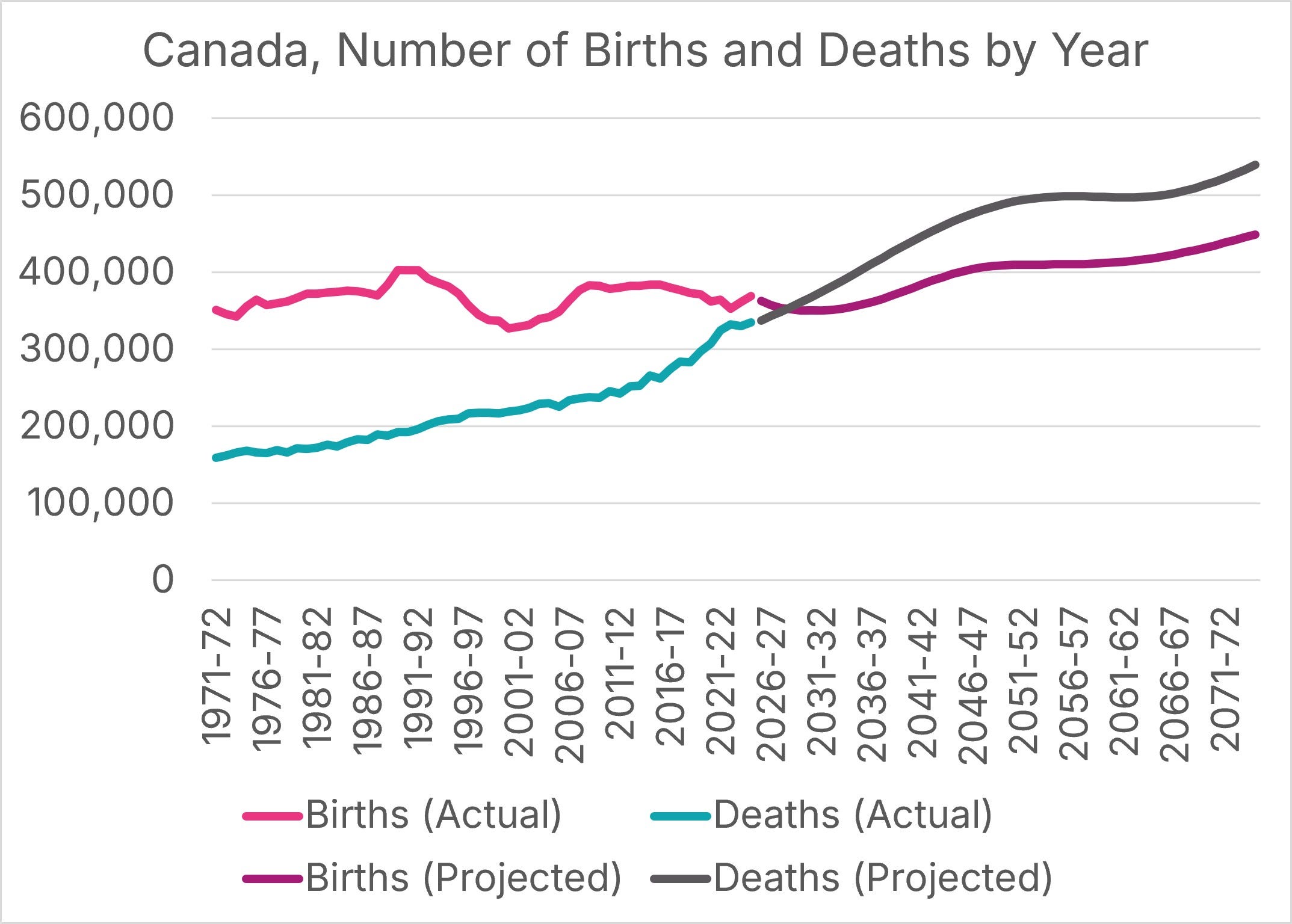
Part of that argument is true. Statistics Canada provides population projections through 2025 (Table 17-10-0058-01). Their M1 projection, based on current trends and government policies, shows deaths overtaking births by the end of the decade, resulting in net population decline from non-migration sources.
Figure 1: Births and Deaths by Year, Number of Persons, Canada.
Data Sources: Statistics Canada Tables 17-10-0008-01 and 17-10-0058-01. Chart Source: MMI.
However, the “we don’t need more homes” argument neglects to consider the role that immigration and non-permanent residency play in population growth and demographic-based housing demand. While Canada’s current immigration plan only extends until the end of 2028, the federal government has made the following three long-term immigration commitments:
reduce our temporary population to less than 5% of the total population by the end of 2027
stabilize permanent resident admissions at less than 1% of the total population after 2027
increase the Francophone immigration target to 12% of permanent resident admissions by 2029
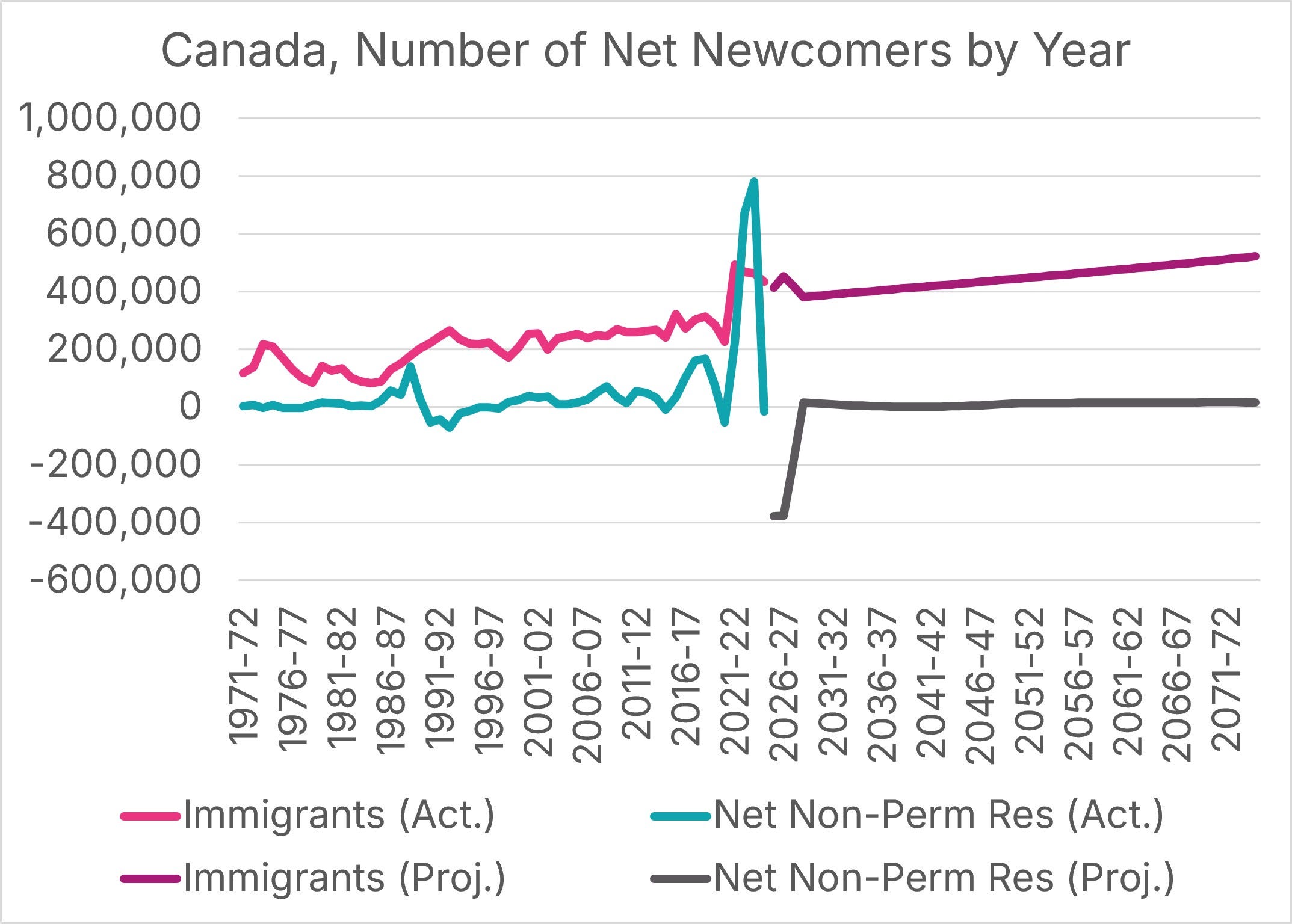
The third commitment is not particularly relevant to our discussion here, but the first two inform Statistics Canada’s population projections. Figure 2 shows the number of new immigrants (permanent residents) and non-permanent residents by year, projected from 1971 to 2075. The post-2015 run-up in immigration and non-permanent residents is clearly visible, along with the 2025-27 reduction in non-permanent residents.
Figure 2: Net Newcomers (Immigrants and Net Non-Permanent Residents) by Year, Number of Persons, Canada.
Data Sources: Statistics Canada Tables 17-10-0008-01 and 17-10-0058-01. Chart Source: MMI.
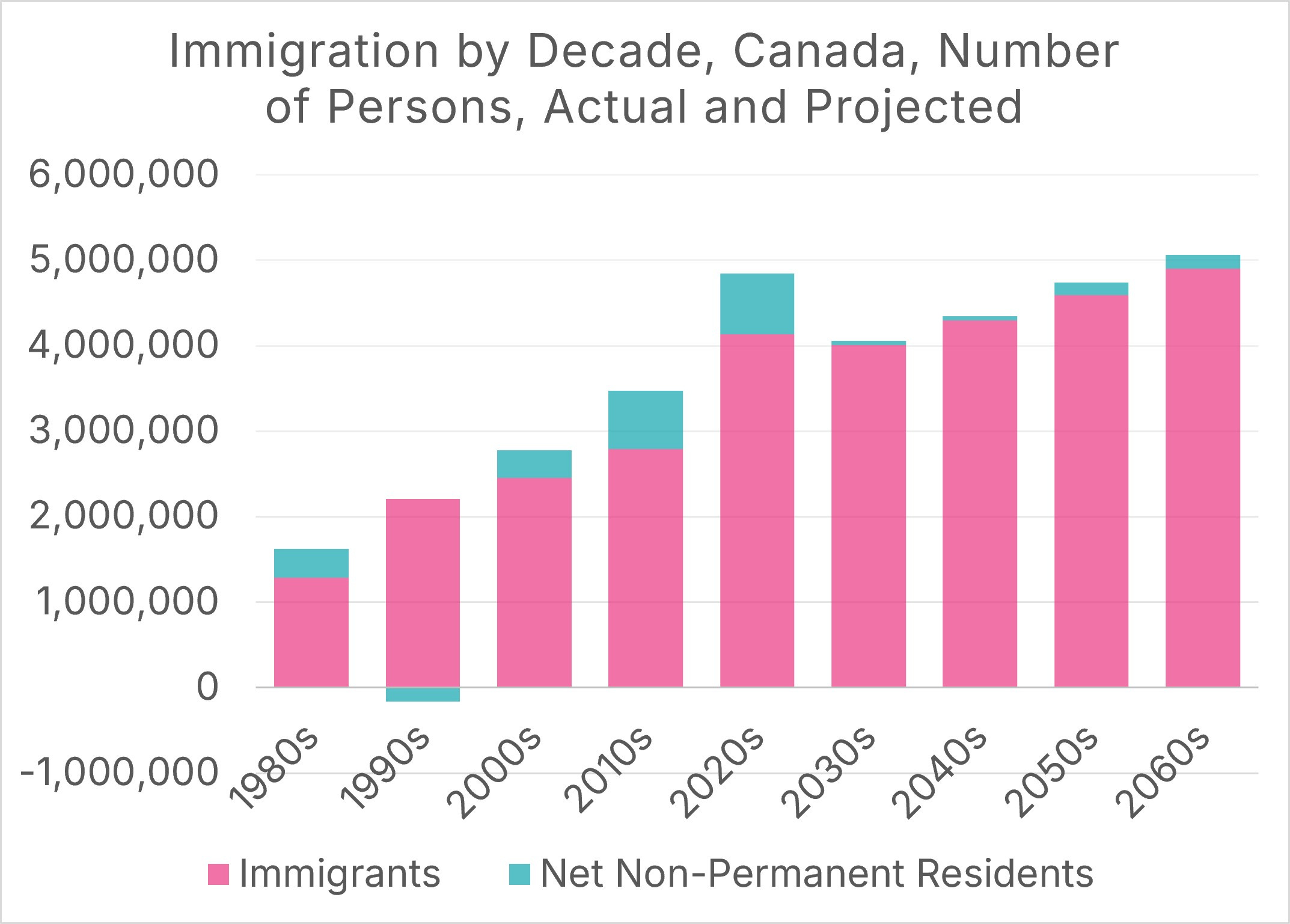
The fluctuations in the 2015-28 period overwhelm Figure 2. We can correct for that by displaying the number of newcomers by decade. In Figure 3, we see that under current Canadian government policies, the number of newcomers to Canada will be just over 4 million in the 2030s, eventually surpassing the 4.8 million in the 2020s and reaching 5 million by the 2060s. In contrast, Canada added only 2 million newcomers in the 1990s.
Figure 3: Net Newcomers (Immigrants and Net Non-Permanent Residents) by Year, Number of Persons, Canada.
Data Sources: Statistics Canada Tables 17-10-0008-01 and 17-10-0058-01. Chart Source: MMI.
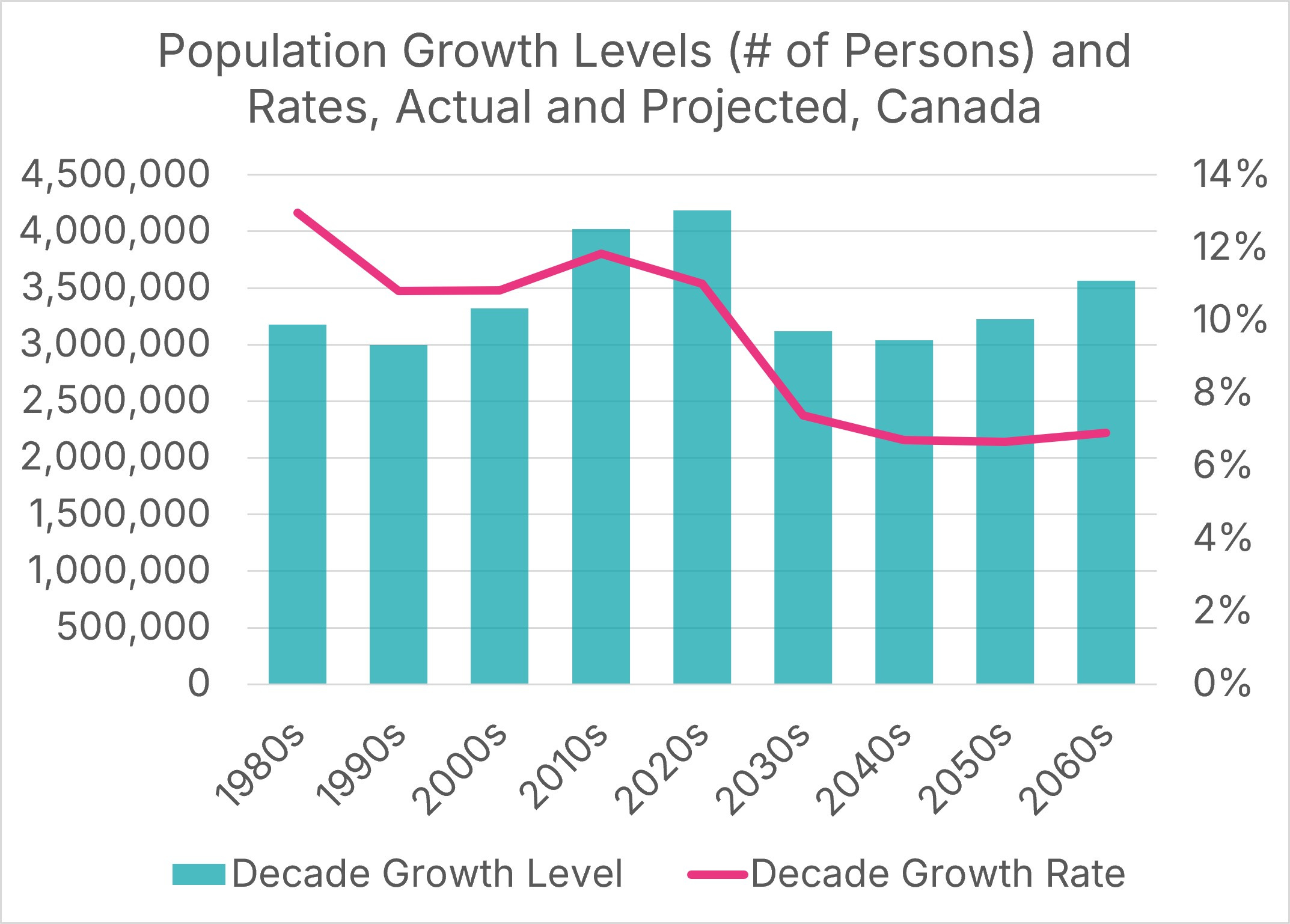
Adding all of the components of population growth and decline together from births to deaths to immigration to emigration, Statistics Canada projects that Canada’s population will grow by just over 3 million persons per decade moving forward, roughly the same level as in the 1980s, a period where Canada built a lot of homes, particularly family-sized homes. Figure 4 shows that while Canada’s population growth rate will be much lower than it was in the 1980s and 1990s, our growth in terms of the number of people is projected to be equivalent.
Figure 4: Population Growth (Number of Persons) and Population Growth Rate by Decade, Canada.
Data Sources: Statistics Canada Tables 17-10-0008-01 and 17-10-0058-01. Chart Source: MMI.
There are all kinds of assumptions baked into these projections, with future immigration policy being at the top of the list. If Canada alters immigration targets, makes drastic increases (or decreases) to the number of non-permanent residents, or finds itself in a position where it cannot achieve the targets it has set for itself, growth rates and growth levels will be substantially different than what is shown in Figure 4.
Barring large reductions in immigration, however, deaths surpassing births does not create a Canada where homebuilding is no longer necessary.
Come on Mike - nobody knows what the future level of immigration will be... and "less than one percent" does not mean "exactly one percent".
Carney is promising to bring NPRs to under 5%, but again, that does not mean it will remain at exactly 5% forever. It was under 1% if we go back a few years, because NPRs left in roughly equal numbers to we let in - mostly seasonal workers.
In fact, the 1% number comes from a fiction that many pro-immigration promote - that it is an average of past immigration and is therefore reasonable. But it was only the average if you use 1900-1990, which includes the high growth 1900-1914 era when we filled up the Prairies.
AND Carney is promising to double the 250,000 homes we build now to 500,000. Even the 250,000 we build now implies more than 1% net growth - and you seem to ignore emigration here. 500,000 homes would mean population growth of well over 1 million a year. Not going to happen.
Furthermore, even with a completely static or declining population, as Canadians get richer they will want and be able to afford more and better space. We need to build more (and tear down more old structures) so that we aren't stuck with houses that are too small and have antiquated insulation, windows, heating/cooling, etc and are full of asbestos.