


Highlights
Housing starts are a terrible real-time indicator of the health of new housing construction. When governments cite housing starts to describe the current health of the market, they are usually talking about investment decisions made two or more years ago. This is because Canada’s uses an idiosyncratic definition of “housing start” which is unaligned with that of our major trading partners.
“Housing starts” don’t mean what Canadians think they mean: Under the CMHC definition, construction can be underway for a year or more before a project is officially counted as having “started,” making the term deeply misleading.
Canada is the outlier, not the norm: Our definition of a housing start is misaligned with those used in the U.S., U.K., and Australia, all of which capture construction activity much earlier in the process.
Alberta is a textbook case of the problem: Strong 2025 housing starts reflect 2023–24 decisions, even as real-time new home sales in Calgary and Edmonton are sharply down.
A real project shows the absurdity: A 292-unit apartment building in New Westminster was under active construction from mid-2023, yet only counted as a “start” in 2025 under CMHC rules long after shovels were in the ground.
We’re using the wrong tool for the job: Treating housing starts as a barometer of current market health is like using a screwdriver to hammer a nail.
Better data would mean better policy. Tracking new home sales and excavation activity, as peer countries do, would give policymakers a far clearer, more timely picture of what’s actually happening on the ground.
You keep using that word. I do not think it means what you think it means.
Every month, the Canada Mortgage and Housing Corporation (CMHC) releases housing start data, and every month it is misinterpreted by many policymakers and members of the media. The blame, however, should not be placed on reporters or politicians, but rather on Canada’s definition of “housing start” which is problematic in three distinct ways:
The word “start” misleads, as the actual construction of the building can begin (a synonym for the word start) a year or more before it meets the CMHC criteria to be considered a start, which is when the foundation is complete and at grade.
The way that Canada measures a housing start is unaligned with housing start measures used is in other G20 countries.
Housing starts are used by government as a real time indicator of the health of the housing market, when they, in reality, reflect business decisions made two or more years ago.
The last point is particularly critical. A recent example of this a December 2025 exchange in the House of Commons Human Resources Committee between Housing Minister Gregor Robertson and Conservative Housing Critic Scott Aitchison. In response to a question on the use of metrics, Robertson cited housing starts as a primary indicator, and suggested that they show that Alberta’s new housing market is doing “very well”.
Figure 1: How housing start data is used

Source: Open Parliament.
And while it is absolutely true that Alberta’s housing starts in 2025 were exceptionally strong, that data reflects the state of the market in 2023 and 2024, when those investment decisions were made. Pre-construction/new housing sales data from Altus Group, a better real-time indicator, tells a different story in Alberta:
Calgary new townhouse home sales are down 17% year-over-year.
Calgary new apartment condo home sales are down 53% year-over-year.
Edmonton new townhouse home sales are down 17% year-over-year.
Edmonton new apartment condo home sales are down 14% year-over-year.
In short, housing starts provide an exceptionally poor real-time indicator of the state of new housing construction. But it does not have to be this way.
A real-world example of how housing starts are measured
In How the U.S., U.K., and Australia Measure Housing Starts Better Than We Do we saw how Canada defines a housing start differently than other countries do. We can illustrate this with a real-world example.
In January 2023, Wesgroup Properties made the investment decision to proceed on the construction of a 292-unit, mixed-use apartment building with direct access to Sapperton Skytrain Station in New Westminister, British Columbia. The site is across the street from Royal Columbian Hospital, and the building will contain retail space, as well as office space for use by the hospital. There will also be five levels of underground parking and bike storage space.
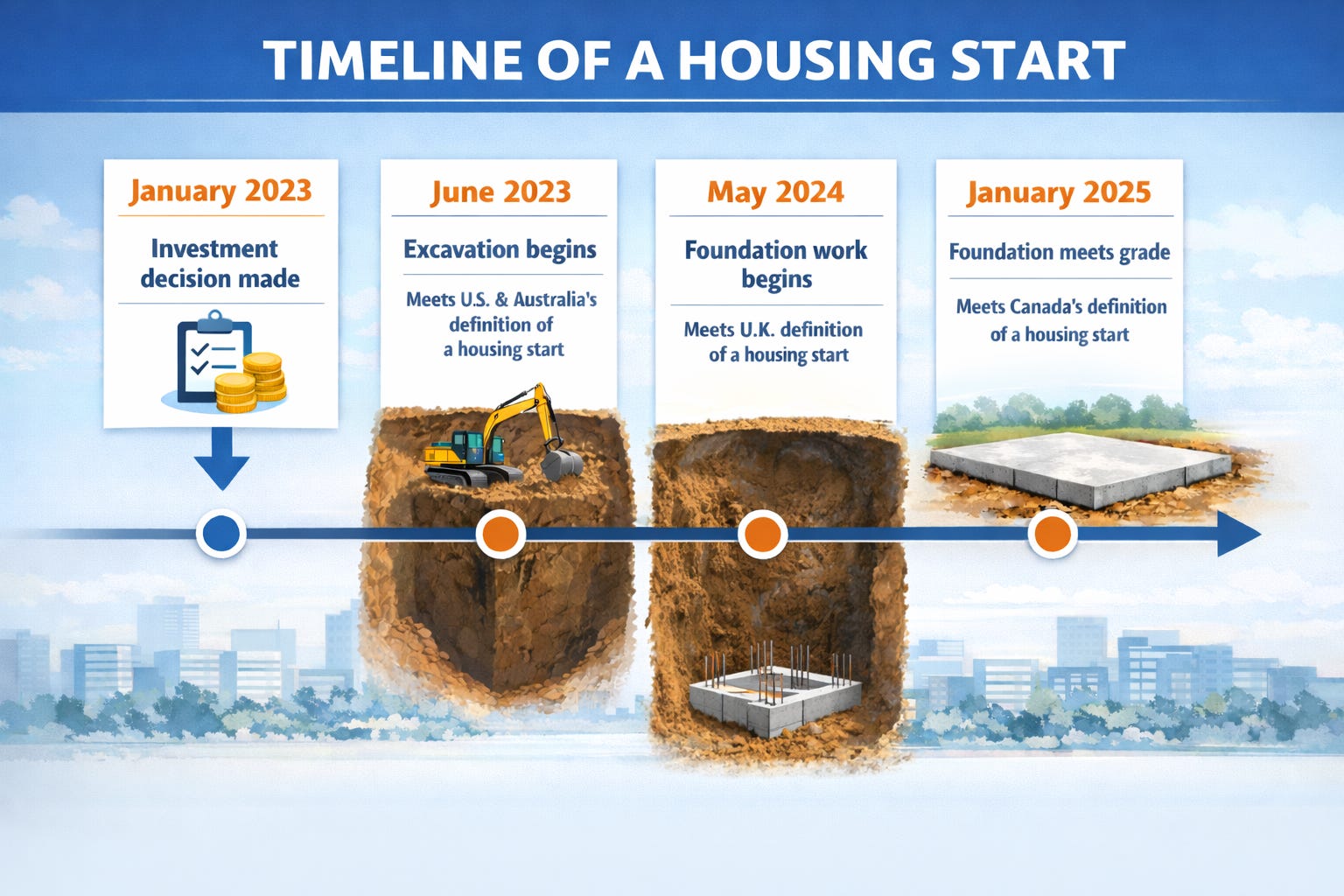
Because of the length of time it takes to excavate and construct a five level underground parking garage, and have that foundation reach grade, the CMHC did not count this building as a housing start until 2025. However, under the U.S. and Australian definitions, it would have been counted in June 2023. Under the U.K. definition, it would have been counted as a May 2024 start, as shown in Figure 2.
Figure 2: Timeline of a real-world housing start, and how it would be measured in the U.S., Australia, the U.K. and Canada
Source: MMI.
In other words, the 2025 housing start data for New Westminister reflects investment decisions made in early 2023, and excavation activity that started in the summer 2023. As such, it reflects the state of the market in 2023, not the state in 2025.
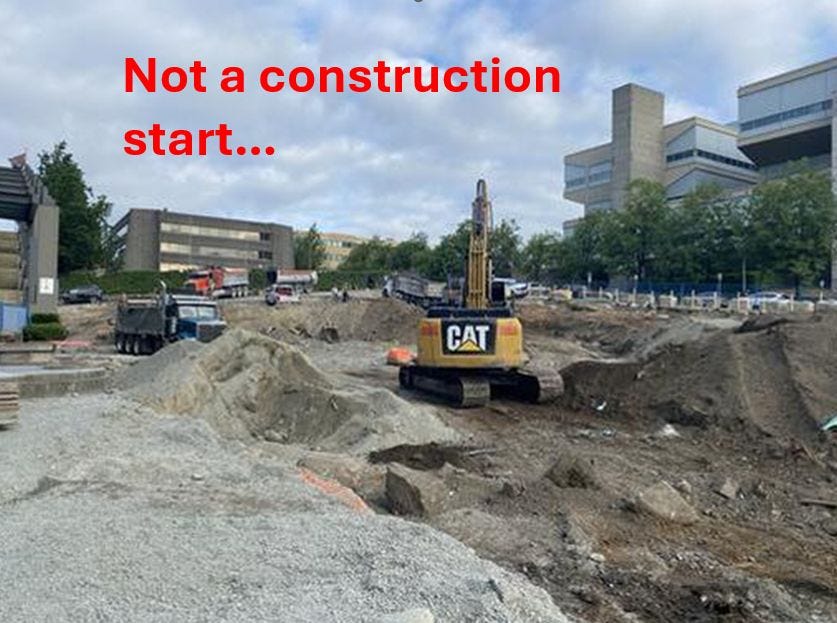
To provide additional context, Wesgroup helpfully provided photos of this project. Figure 3 shows the site work taking place in mid-June 2023. The U.S. and Australia would consider this activity sufficient to say that the work had “started” on this building, and I believe most reasonable Canadians would as well. But it does not meet Canada’s definition of a housing start, nor does it mean the U.K.’s.
Figure 3: Shovels in the ground on June 13, 2023. Does not meet the CMHC definition of a housing start, but does meet the U.S. and Australian definitions.
Source: Wesgroup.
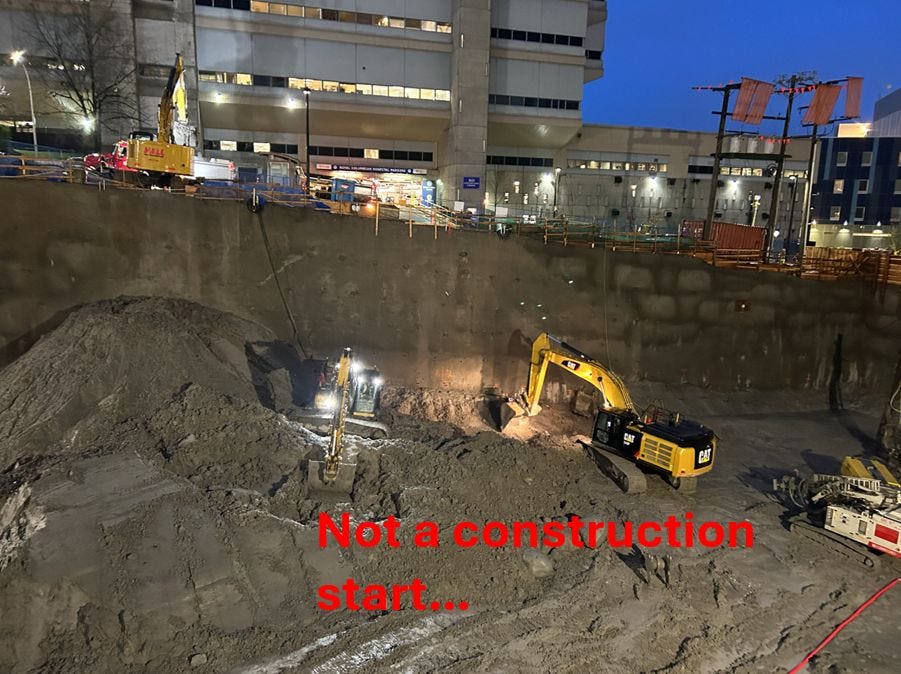
Fast forward to just before Christmas in 2023. That hole has gotten very large, with substantial activity taking place. But this is still not a housing start.
Figure 4: Construction as of December 19, 2023. Still not considered a housing start.
Source: Wesgroup.
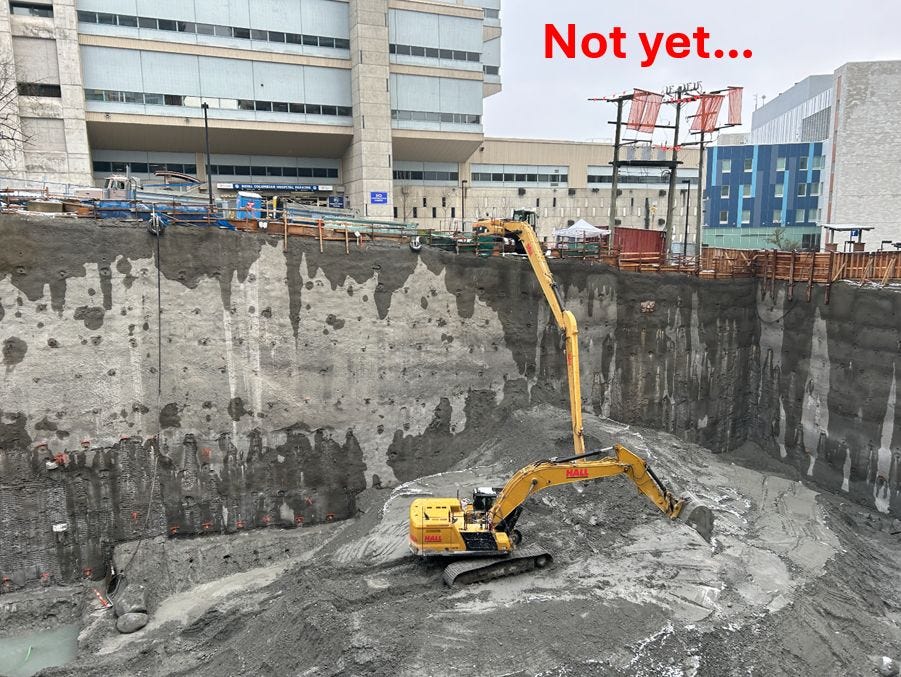
The hole has gotten even larger by February, and foundation work is about to begin. Still not a housing start.
Figure 5: February 29, 2024. Over 8 months of on-site work, but still not classified as a housing start.
Source: Wesgroup.
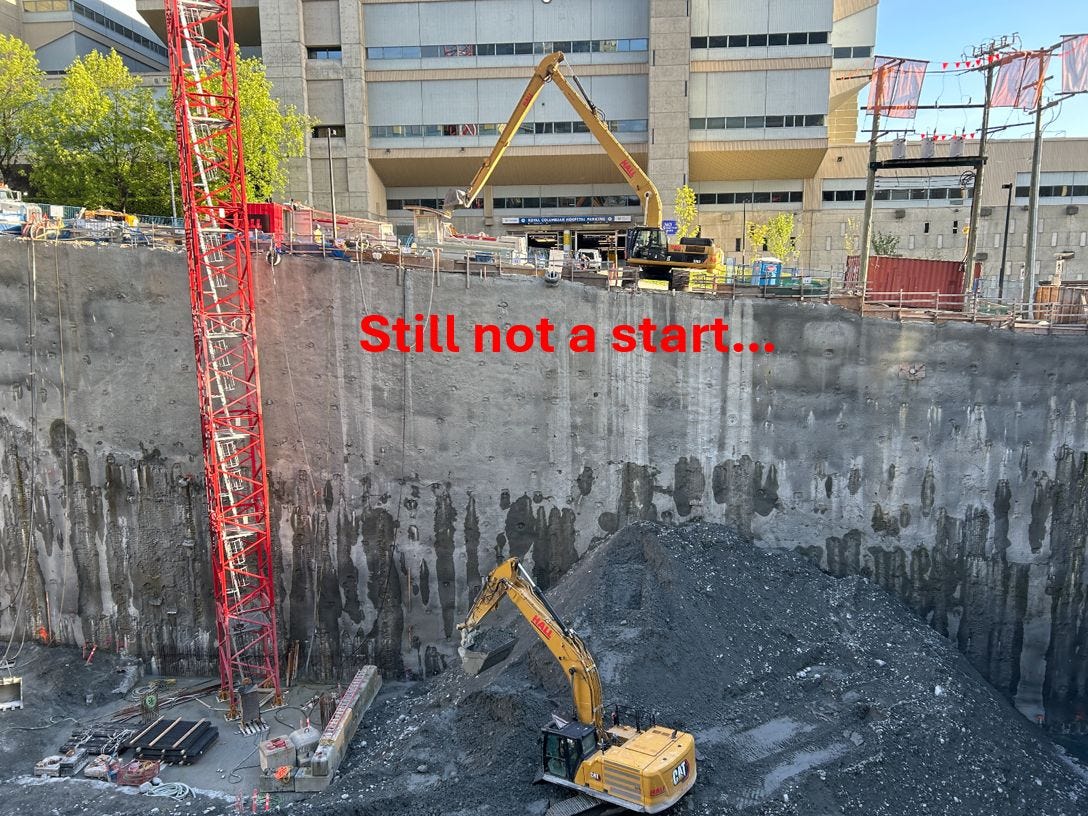
By May 3rd, 2024 some foundation work has begun. At this point, the United Kingdom would now classify this as a housing start. In fact, they would have likely considered it in March or April. In Canada, however, this still does not qualify as a housing start.
Figure 6: May 3, 2024. Still does not meet the CMHC classification of a housing start, but now meets the U.K. definition.
Source: Wesgroup.
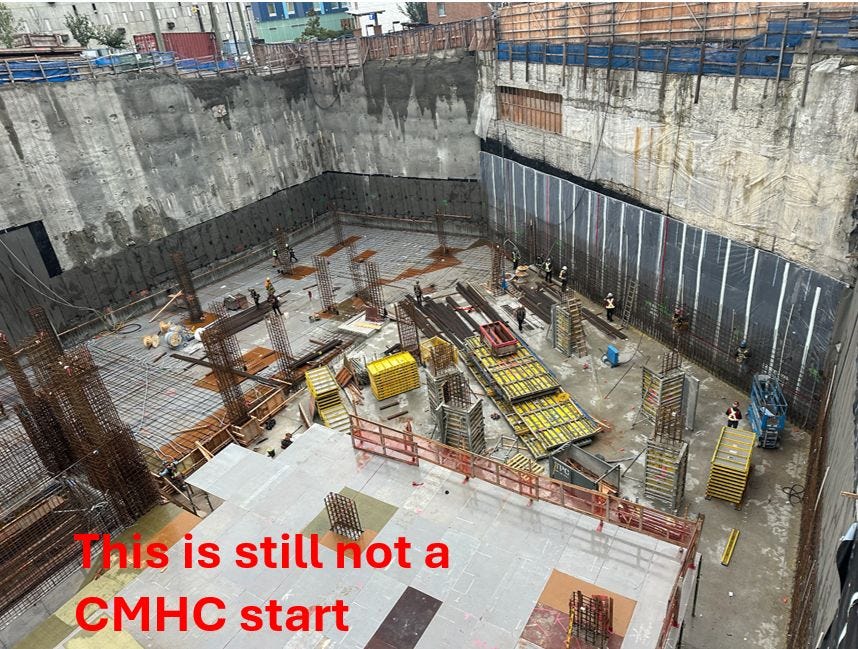
Going into fall 2024, over a year after on-site work had started, and this is clearly not just a “large hole in the ground”, yet it is still not classified as a construction start.
Figure 7: September 30, 2024. Past the one-year anniversary of on-site work. Still not a housing start.
Source: Wesgroup.
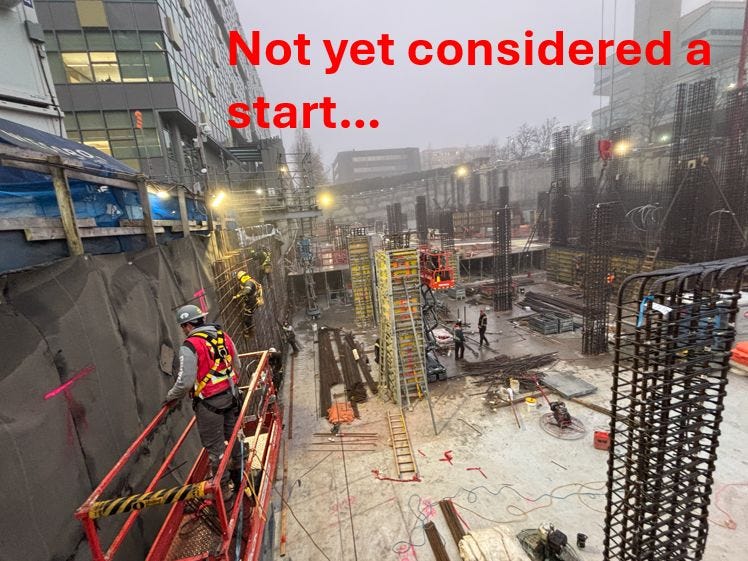
Fast forward to December 2024. We would love to see an elected official or a public servant tell these construction workers that they have not started construction.
Figure 8: December 3, 2024. Despite 16 months of activity, and the visible appearance of busy workers, they have not started working on the building, under the Canadian definition of the term.
Source: Wesgroup.
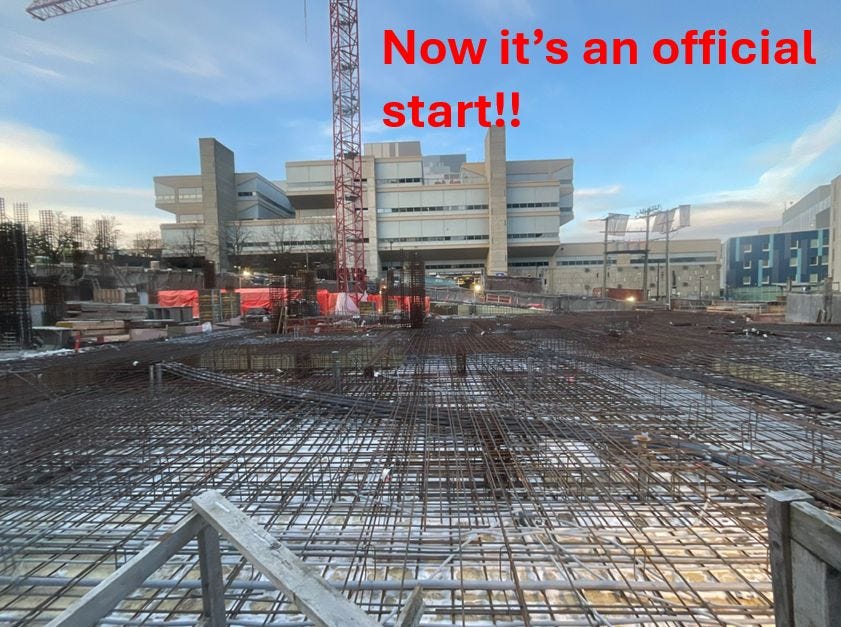
Finally, a year and a half later, the foundation has reached grade, and the CMHC would include this site in their housing start data.
Figure 9: January 31, 2025. A year and a half later, the foundation has reached grade, and the building, and the units it contains, have deemed to be “started”, and (hopefully) will be included in the January 2025 or February 2025 housing starts data, though there can be delays in measurement.
Source: Wesgroup.
In short, Canadians, including those in our governments, are being misled by our housing start data, because the CMHC uses a definition that defies any common-sense definition of the word “start”, that is ill-suited for use as a leading indicator of the health of new housing construction. That is not to suggest that the current definition lacks utility; it does provide a good indicator of what housing completions will be 1-3 years from now. But using Canada’s definition of housing starts as a barometer of new housing construction is like using a screwdriver to hammer in a nail. It’s the wrong tool for the job.
There are solutions to this. First, the CMHC should track new housing sales, and make that data freely available. Second, they should also track excavations, like the U.S. and Australia, to provide a better real-time indicator of new construction activity.
Those two changes would give policymakers a much clearer picture of the state of new housing activity in Canada.