


The week of November 2nd will be a consequential one for North America. Americans head to the polls for the midterm elections on November 3, while Canadians will get a second detailed look at the Carney government’s economic priorities when the federal budget is released on November 5.
Both events will be dissected for their political implications, but it is worth considering the household financial context surrounding these events as well.
Prime Minister Carney continues to ride a wave of goodwill and public support. Canadians recognize he inherited a difficult geopolitical and economic environment, and many credit him with creating momentum after years in which governments often appeared unable to move forward.
Meanwhile, President Trump faces a much more skeptical public. After promising affordability improvements that many Americans have yet to feel in their own lives, frustration remains elevated.
The headlines in both countries are focused on today’s affordability challenges. In the United States, affordability is increasingly cited as a factor improving Democratic prospects. In Canada, it is often used to explain support for the Build Canada agenda. Yet a closer look at how Americans and Canadians view their future, and the future of the next generation, suggests a more complicated challenge for political leaders.
Our October 2026 Ipsos Canada-U.S. tariff study finds Canadians are less optimistic than Americans about both their own economic prospects and the prospects of the next generation. That does not mean the American picture is positive. It does suggest that in both countries, governing parties will soon need to shift from responding to today’s affordability concerns to rebuilding confidence in tomorrow’s opportunities.
Overall, 47% of Canadians and 57% of Americans expect their household’s financial situation to improve over the next three years. At the same time, 66% of Canadians and 60% of Americans believe young adults no longer have a realistic opportunity to build a better life than the generation before them.
The data reveals a growing paradox. While many people still believe their own circumstances may improve, a majority in both countries have lost confidence in generational economic mobility. Hope for the near term remains, though in Canada it falls short of a majority. Confidence in the longer-term promise that each generation will do better than the last is eroding.
The generational results are even more revealing. Younger Canadians and Americans are more optimistic than older generations about their own finances over the next three years, but American optimism exceeds Canadian optimism in every age cohort.
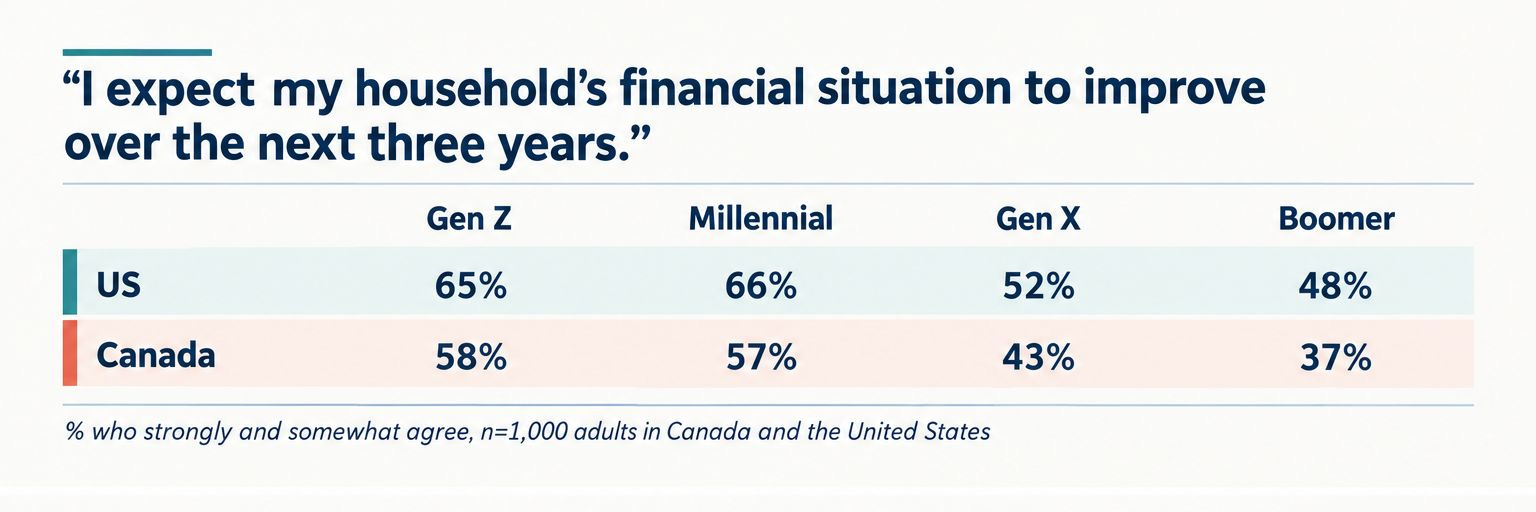
Yet when asked about generational mobility, younger respondents are the most pessimistic. Majorities of Gen Z and Millennials in both countries believe young adults no longer have a realistic opportunity to build a better life than their parents. Canadians are consistently more likely than Americans to hold this view.
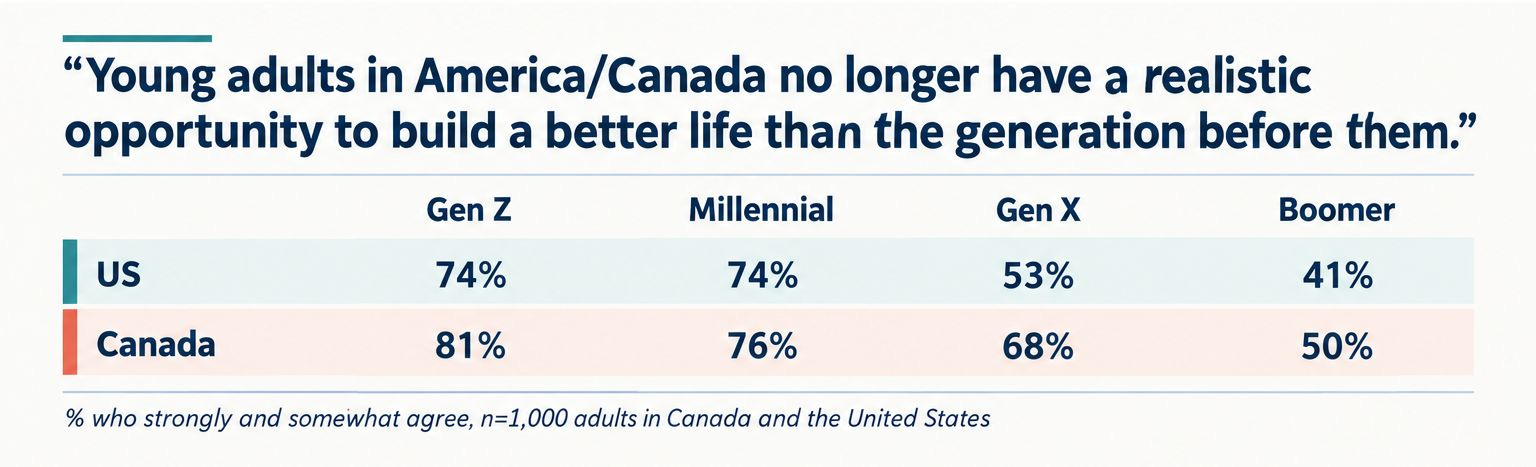
Affordability is today’s problem. Economic mobility is tomorrow’s problem. Citizens can tolerate difficult economic periods if they believe progress remains possible. Once they lose confidence that hard work will lead to a better future for themselves or their children, the challenge becomes much larger than affordability alone.
Canadians and Americans are beginning to question the economic promise that previous generations took for granted. Beyond November, political success in both countries will ultimately depend on improving household finances in the near term, and on restoring confidence that the next generation can move further ahead than the one before it. Both are equally important.
People who believe economic challenges are temporary tend to wait for conditions to improve. People who believe those challenges are permanent adapt. They lower expectations, change spending habits, delay major decisions, and increasingly rely on themselves rather than institutions.
In fact, 68% of Canadians and 62% of Americans told us in June 2026 that they have lowered their expectations of what a “good” standard of living looks like compared to a year ago.
This does not mean citizens have abandoned hope. They are still looking for leaders, policies and institutions that can restore their confidence in the future. Prime Minister Carney’s approval ratings and improving assessments of the country’s direction may be an early manifestation of that hope, but those gains have not yet translated into significantly greater optimism about household finances.
By the end of November, Canada and the United States may appear to be moving in very different political directions. One government may enjoy growing momentum while the other faces mounting political challenges. Both Canadians and Americans want to believe that tomorrow will be better than today. Neither the midterm election nor the federal budget will be enough on its own to change that outlook.
Over the winter months, the household finances in both countries should be what we are watching: whether inflation is passed on from business to consumers, whether the weak labour market for young people spreads to older cohorts, and whether interest rates take a bigger bite out of weekly budgets.
Household resilience will determine political patience, and political capital is not infinite. President Trump has to show that conditions are turning around. Prime Minister Carney has to prove that the announcements and investments will eventually show up, especially in the less resilient households across Canada.
Michael Colledge is Executive Insight Lead, Ipsos Canada.
The views expressed in this article are those of the author and do not necessarily reflect the views of the Missing Middle Initiative or its affiliates.
MMI accepts guest submissions between 700 and 1200 words; they can be submitted via e-mail to [email protected].
Are these cross-border differences new, or historic/cultural? Americans are always touted by themselves and others as relentlessly optimistic. Canadians do not have that reputation. A mere snapshot survey does not show whether the difference self-assessment of optimism is new or systemic.