


Highlights
Renovations rival new construction as an economic driver: Ontario’s residential construction sector supports 457,000 jobs and contributes nearly $57 billion annually to the province’s GDP, with renovations alone accounting for roughly 40% of all employment and activity.
More than 170,000 jobs depend on renovations: When both direct and indirect effects are considered, home renovations generate over 170,000 jobs, $11.3 billion in wages, and $21 billion in GDP, a cornerstone of Ontario’s $1.2 trillion economy.
Renovations are key to climate progress: With 70% of Canada’s 2050 building stock already built, retrofitting existing homes is essential to cut the 18% of national greenhouse gas emissions linked to buildings and achieve federal climate goals.
Essential for safe, suitable, and aging-ready homes: Over 400,000 Ontario households live in homes that are in need of major repairs, while most Baby Boomers plan to age in place, all underscoring the need for ongoing home upgrades and accessibility retrofits.
A quiet economic and social powerhouse: While policymakers should not lose focus on new construction, renovations also sustain middle-class jobs, maintain housing quality, enable climate action, and let families and seniors stay rooted in their communities.
New homes aren’t always built; often, they’re rebuilt from existing homes
In recent months, pieces such as “The GTA’s Housing Collapse: Governments Lose $6B+ Annually“ have highlighted the importance of the homebuilding sector to Ontario and Canada’s economy, and how a slowdown in new home sales and new housing construction will lead to a loss of employment and tax revenue. MMI often makes the point that governments can become so focused on losing tax revenue from measures such as reducing the GST on new homes that they often lose sight of the cost of inaction and the lost tax dollars resulting from declining housing construction.
We thought it would be helpful to put the size of Ontario’s housing construction sector into context. Doing so reveals that both the building of new homes and the renovation of existing homes are key drivers of Ontario’s economy.
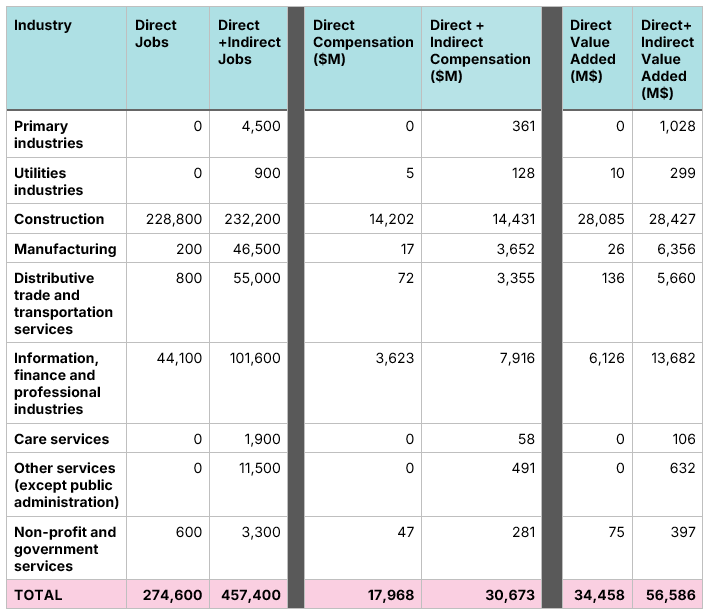
Statistics Canada Table 36-10-0679-01 contains three key economic indicators related to the residential construction sector: the number of jobs in the sector, the total compensation of those workers, and the sector’s contribution to the province’s GDP. In 2024, residential construction in Ontario directly accounted for 274,600 jobs, nearly $18 billion in employee compensation, and over $34 billion in economic activity, as shown in Figure 1. When indirect (spin-off) economic activity is taken into account, the sector is responsible for 457,000 jobs, over $30 billion in compensation, and nearly $57 billion in economic activity. These figures represent approximately 5.5% of Ontario’s workforce of 8.2 million people and its $1.2 trillion economy.
Figure 1: Direct and indirect jobs, compensation, and direct value added for Ontario’s residential construction sector, 2024
Data Source, Statistics Canada Table 36-10-0679-01, Chart Source: MMI.
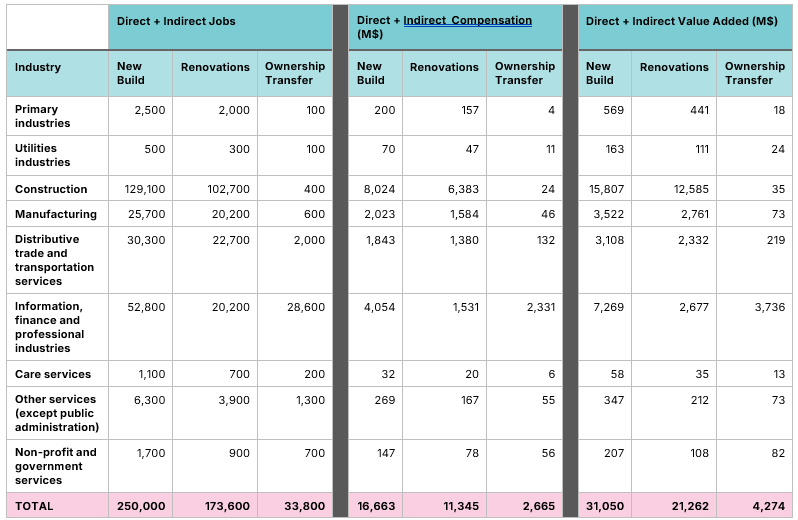
Not all direct and indirect employment and economic activity in residential construction stems from the building of new homes. Statistics Canada divides the sector into three activities: new home building, renovations, and ownership transfer. Figure 2 shows that the renovation portion of residential construction accounts for approximately 40% of direct and indirect employment and economic activity in the sector. When both direct and spin-off activities are considered, renovations contribute over 170,000 jobs, more than $11.3 billion in employee wages, and $21 billion in GDP to Ontario’s economy each year.
Figure 2: Direct and indirect jobs, compensation, and direct value added by subcomponent of Ontario’s residential construction sector, 2024
Data Source, Statistics Canada Table 36-10-0679-01, Chart Source: MMI.
Ontario’s renovations sector also plays a vital role in achieving several environmental and social goals. For example, a recent Efficiency Canada report highlights how well-designed retrofits can simultaneously reduce or eliminate operational greenhouse gas emissions from buildings, improve energy efficiency, lower energy bills, and alleviate energy poverty. There is no pathway to reaching Canada’s climate goals without renovations and retrofits, as 18% of greenhouse gas emissions are related to buildings. The Pembina Institute estimates that 70% of the buildings that will exist in Canada in 2050 already exist today, further highlighting the role that renovations will play in Ontario and Canada’s climate ambitions.
The renovation sector is also vital in ensuring that homes remain in good repair and are suitable for their occupants. A Statistics Canada/CMHC study finds that, of Ontario’s 5.8 million households, nearly 400,000, or 6.6% live in unsuitable housing and need to be expanded in order to house their occupants comfortably. Additionally, over 400,000, or 7.0% of Ontario’s 5.8 million households, live in homes that require major repairs. An additional 1.3 million live in homes that need minor repairs, and the remaining 4.1 million have housing that requires regular maintenance.
Renovations are also crucial for allowing seniors to age in place comfortably. A 2017 report by Home Modification Canada finds that 85% of Baby Boomers plan to age in place in their existing homes. Accessibility features and other modifications can help an aging population live safer, more comfortable lives. Others wish to renovate to improve the aesthetics, functionality, or re-sale value of their home, with a 2025 CMHC study finding that 74% of homeowners plan to renovate at some point in the next 5 years.
In short, while our housing focus has been, and will continue to be, the creation of new supply, the importance of the renovations sector should not be overlooked.
