


Highlights
One government cuts, another collects: Twice in three years, Metro Vancouver raised development charges just after another level of government lowered taxes on new housing, capturing the savings instead of lowering total costs.
The 2023 GST cut was effectively neutralized: Ottawa’s removal of the GST on purpose-built rentals was followed within days by Metro Vancouver’s plan to raise DCCs, undoing much of the intended benefit.
The City of Vancouver tried to intervene as housing starts collapsed: In December 2025, City Council approved a temporary 20% cut to Development Cost Levies to support stalled projects.
Metro Vancouver didn’t follow suit: Despite acknowledging that development charges deter construction, Metro Vancouver left large DCC increases in place, including a hike taking effect January 1, 2026.
The math is brutal: For a typical 100-unit apartment building, Metro Vancouver’s DCC increase can fully offset the City of Vancouver’s DCL cut—leaving total per-unit charges unchanged.
The devil lurks in the details
Development charges are complex, and that complexity can allow one level of government to undo the good work of another level. Nowhere is this more true than in Vancouver, where development is subject to both Development Cost Levies assessed by the City of Vancouver and Development Cost Charges by the Metro Vancouver Regional District. The complex nature of these charges led the CMHC to exclude Vancouver from its recently released Development Charge database.
The complexity has also allowed Metro Vancouver to hike their development charges after another level of government lowered the taxes on new construction, thereby capturing those savings for itself. This has happened at least twice in the last three years: once in 2023 and again this month.
Round 1: The feds cut, Metro Van hikes
On September 14, 2023, in a press conference in London, Ontario, Prime Minister Trudeau announced that the federal government would remove the GST on purpose-built rental construction. The measure, one of the key recommendations in the National Housing Accord, applies to projects that begin construction between the announcement date and the end of December 2030 and can save tens of thousands of dollars on the construction of a new rental apartment unit.
Less than one week later, on September 19, the Metro Vancouver Regional District (Metro Van) outlined a plan to increase Development Cost Charges (DCC) substantially and hosted two webinars on September 20 and September 22, which provided additional details.
It became clear that the DCC increase would undo any savings provided by the GST cut, allowing Metro Van to absorb the benefits. Not only did that keep construction costs high, but it also embarrassed the federal government, which saw its efforts to lower homebuilding costs thwarted.
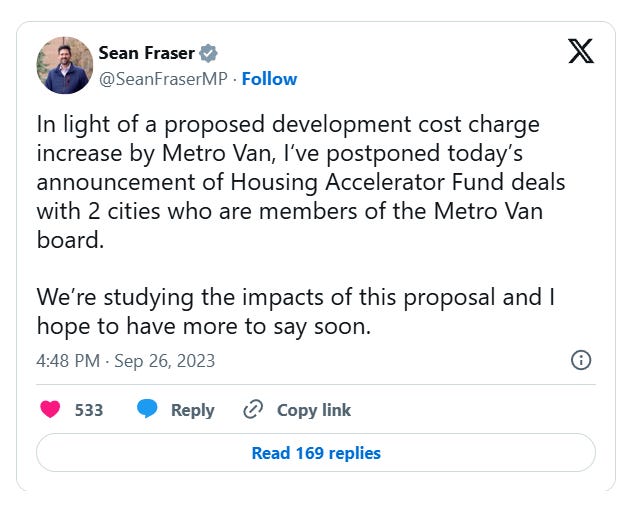
In response, then Federal Housing Minister Sean Fraser announced via tweet that he would postpone the announcement of Housing Accelerator Fund agreements with Burnaby and Surrey.
Figure 1: September 26, 2023, tweet from then Housing Minister Sean Fraser
Tweet Source: City News
One month later, Metro Van voted for the DCC plan, which will lead to regional DCCs more than tripling by the time the increase is fully phased in.
Figure 2: Metro Van DCC rates, as voted on in October 2023
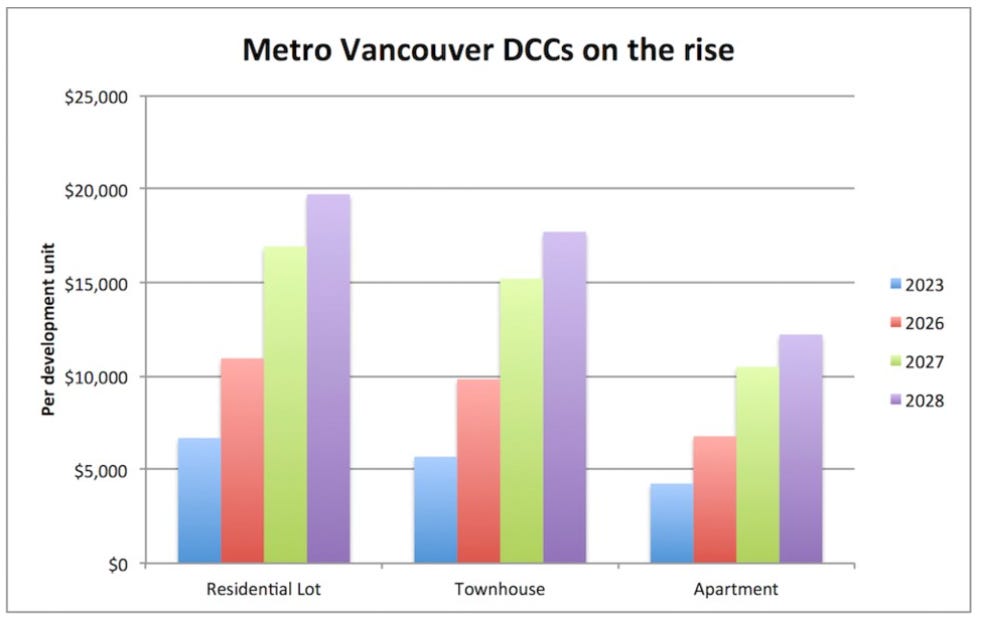
Chart Source: Western Investor.
A new hope
As the Missing Middle Initiative has outlined in previous pieces, housing starts in Vancouver are set to decline substantially, as shown in both new home sales and CMHC forecasts. In response to deteriorating market conditions, the City of Vancouver (a lower-tier municipality inside Metro Vancouver) has decided to act. A June 2025 report from the City contemplated a series of actions to lower the cost of homebuilding. On December 2, 2025, a follow-up report contained additional recommendations, including a 20% cut to Development Cost Levies:
A temporary 20% reduction to city-wide, utilities and area-specific Development Cost Levies (DCLs) to support housing delivery and construction until the Financing Growth Update is brought to Council for approval in Q2 2026.
One week later, the Vancouver City Council would approve the measure.
But the Metro Van DCC increases are still lurking
Like the City of Vancouver, Metro Vancouver also recognizes that development charges negatively impact development and made a number of changes in 2025 to ease the burden, including enhanced in-stream protection to create greater certainty for homebuilders. However, unlike the City of Vancouver, they did not lower development charges, nor did they even reduce or postpone the large development charge hikes that go into effect on January 1st, 2026.
Metro Van’s failure to address development charges re-creates the 2023 scenario, where the cost savings from the federal government’s GST cut were captured by Metro Van, undoing the effort to lower the cost of construction. Now, Metro Van is capturing the benefits of the City of Vancouver’s DCC cut.
A dollar given, a dollar taken away
It is straightforward to model the combined impact of the City of Vancouver’s cut in Development Cost Levies, and Metro Vancouver’s DCC increase. We will use an apartment building as an example.
Let’s suppose we are considering whether to proceed with the construction of an apartment building. The City of Vancouver’s current Development Cost Levies (which do not incorporate the 20% cut) are shown in Figure 3. The city charges by the square foot, and our structure would fall into the category of a residential building with a floor-space ratio (FSR) above 1.5.
Figure 3: City of Vancouver Development Charge Levy rates
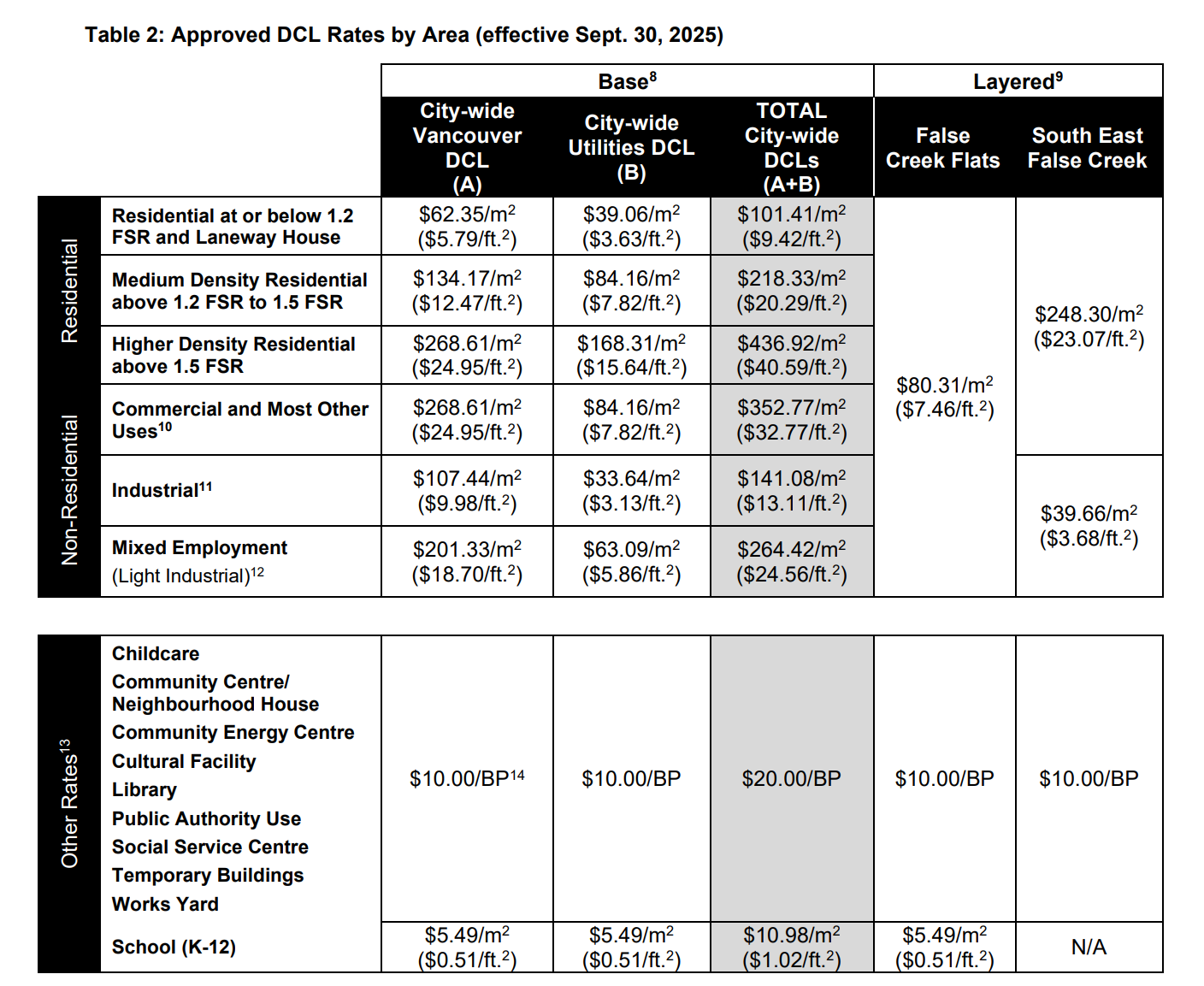
Chart Source: City of Vancouver.
Next, let’s consider Metro Vancouver’s Development Cost Charges for an apartment built in the Vancouver Sewerage Area (VSA). As shown in Figure 4, those fees are charged by the dwelling unit, with those fees rising by over $4,400 per apartment unit on January 1, 2026.
Figure 4: Metro Vancouver Regional Development Cost Charge rates
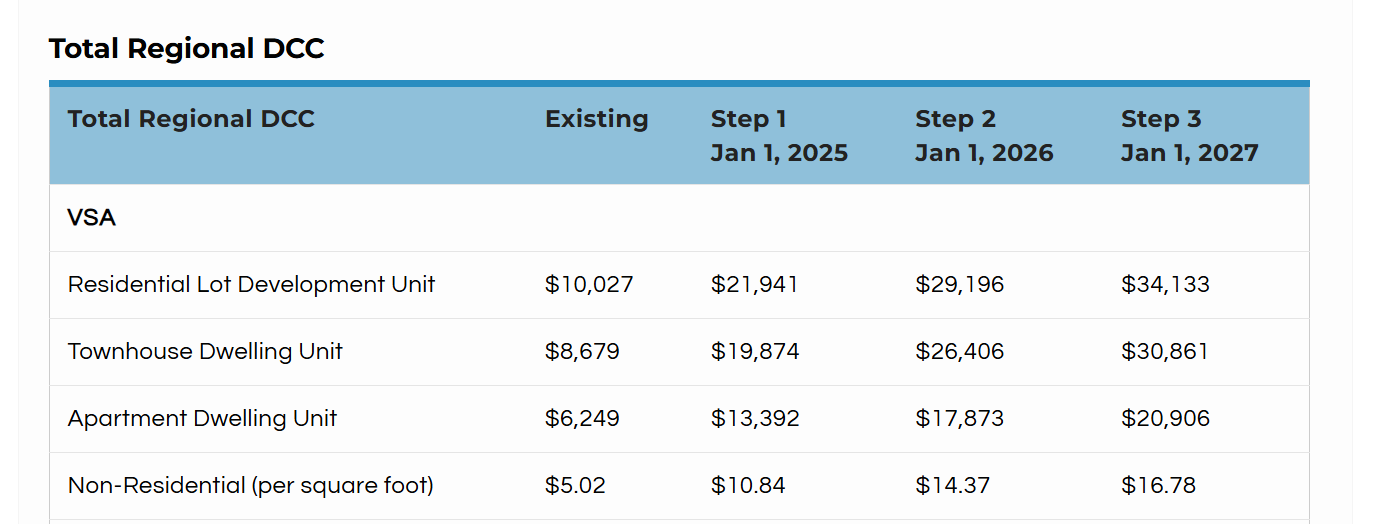
Chart Source: Metro Vancouver
In Figure 5, the two sets of charges are combined into a single chart.
Figure 5: City of Vancouver and Metro Vancouver development charge rates
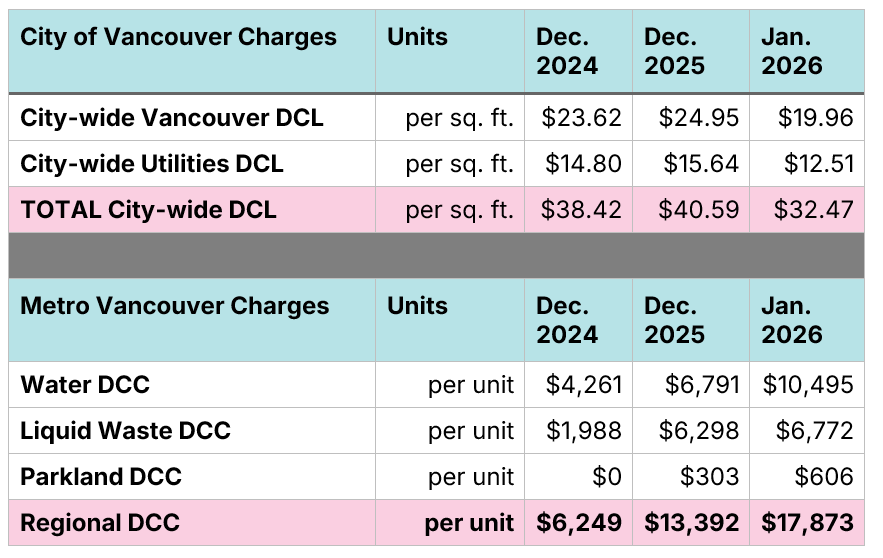
Chart Source: MMI
Because the City of Vancouver charges by the square foot, and Metro Vancouver charges by the unit, the relative impact of the two changes depends on the relative size of the units being built. Let’s suppose we are building a 55,000-square-foot apartment building divided into 100 units.
In that example, the two changes are perfectly offset. Metro Vancouver fully captures the City of Vancouver’s $450,000 DCL reduction for the project, and the total bill remains $35,000 per unit.
Figure 6: City of Vancouver and Metro Vancouver development charges on a 100 unit, 55,000-square-foot apartment building
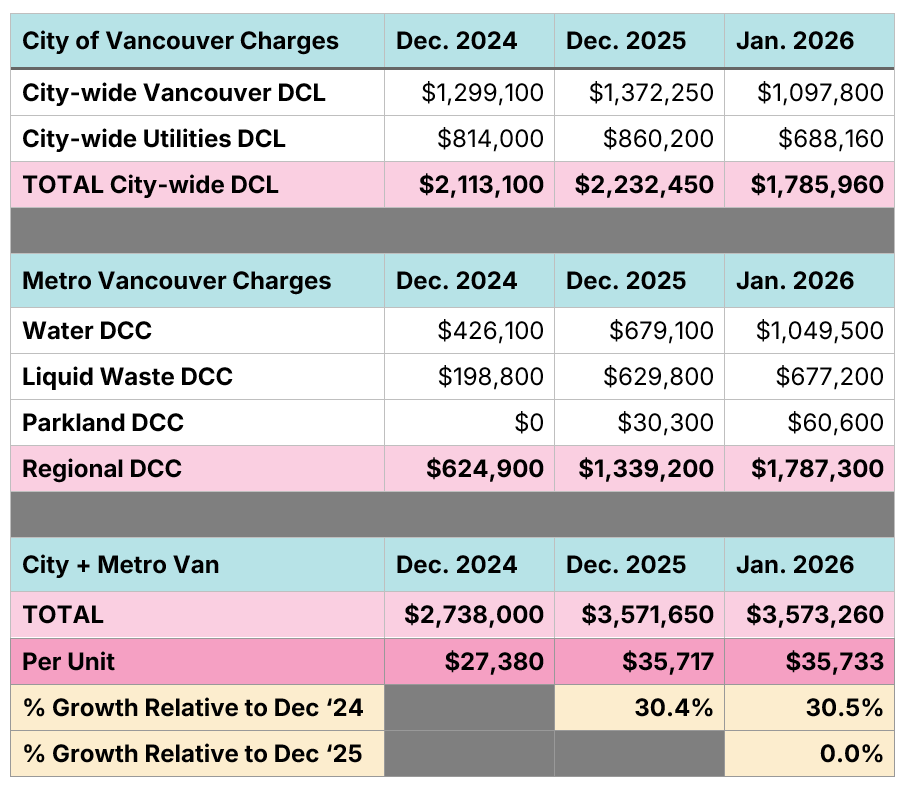
Chart Source: MMI
There are some net savings if the apartment building has higher average unit sizes. Let’s suppose the number of units stays the same, but the total square footage increases to 80,000 square feet. In that case, the combined effect of the two policies is a 4.4% reduction in the development cost charge relative to 2025, though the combined cost remains over 18% higher than in 2024. Of the $650,000 cut provided by the City of Vancouver, $450,000, nearly 70%, is captured by Metro Van.
Figure 7: City of Vancouver and Metro Vancouver development charges on a 100 unit, 55,000-square-foot apartment building
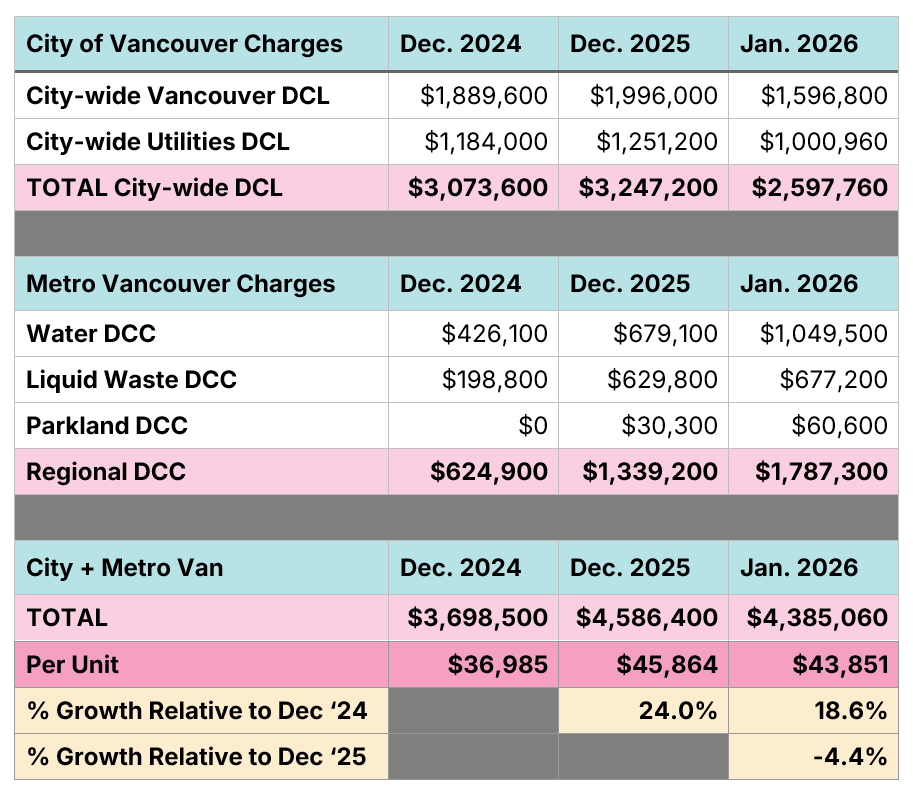
Chart Source: MMI
A lack of coordination
Development has stalled out, as costs are too high relative to returns to make projects pencil out. Governments have tried to address this. The federal government cut the GST on purpose-built rental construction. The City of Vancouver cut DCLs to keep projects alive in a collapsing market. And Metro Vancouver has stepped in twice now to absorb those savings.
Download a PDF version of this piece below:
