


Budget Highlights
A promise halved: The Build Canada Homes program receives barely half of what was promised in the Liberal platform. Instead of $11.8 billion by 2028-29, the Budget funds only $6.2 billion.
Development charge relief diluted: The platform had committed $1.5 billion annual to development charge reduction; this has been reduced to $1.2 billion, and the requirement that development charges be “halved” has been replaced with one that merely requires they be “substantially reduced”.
MURB incentive missing in action: Despite the platform’s commitment to reintroduce the Multiple Unit Residential Building (MURB) tax incentive, the Budget is silent on this measure.
Focus shifts from housing supply to reducing housing demand through scaling back immigration: In a striking departure from past rhetoric, the Budget frames housing affordability improvements as stemming from lower immigration targets and reduced population growth, asserting that Ottawa is “taking back control” of immigration to “bring immigration back to sustainable levels.”
Disappointing is too weak a word
Earlier today, MMI cautioned readers not to expect a housing miracle in today’s Federal Budget. I went into the budget lockup expecting to be disappointed, but I had inadequately prepared myself for how disappointed I would be.
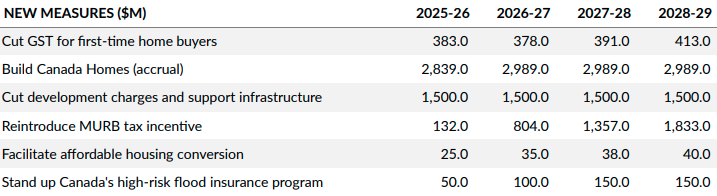
To put the Budget promises into context, Figure 1 lists the housing commitments in the Liberal Party’s campaign platform.
Figure 1: What the Liberal platform promised on housing
Source: Liberal platform campaign costing
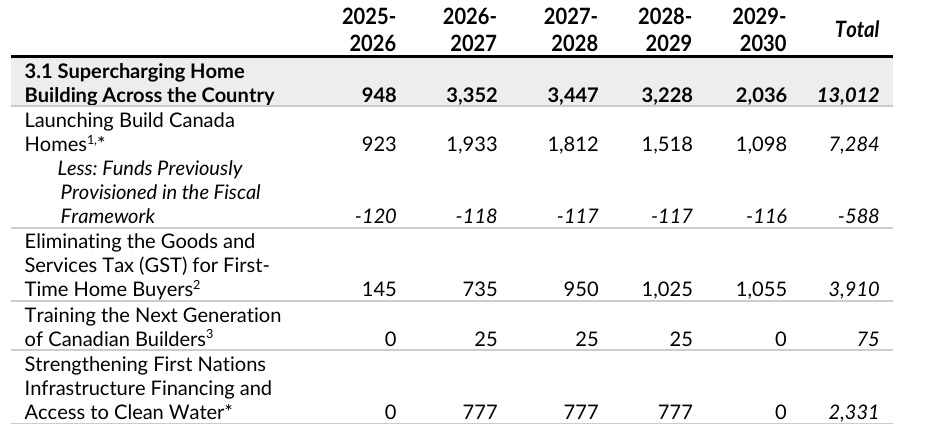
The 2025 federal budget, on the other hand, provided a much more modest set of initiatives.
Figure 2: What today’s budget delivered on housing
Source: Budget 2025
The differences in detail:
Build Canada Homes: The Liberal platform had promised just under 3 billion a year (2.989B) for Build Canada Homes once the program fully ramped up by 2026-27. The Budget allocates an annual average of $1.59B between 2026-27 and 2029-30, just barely over half of what was promised. I asked officials about the discrepancy and was told that investors would roll out slower than anticipated by the platform, but investments would ramp up in later years. Ultimately, during the campaign, the Liberals had promised $11.8 billion in BCH investments through fiscal year 2028-29; instead, they are only investing $6.2 billion.
GST Rebate for First-Time Homebuyers: This commitment remains unchanged from the one in the election platform, but the costing has more than doubled. Finance Officials informed me that they are forecasting a larger number of first-time homebuyers will collect this benefit than the Liberal platform has anticipated; they are expecting over 40,000 first-time buyers to collect the rebate each year, with an average rebate value of approximately $24,000. I am highly skeptical that the actual figures will be anywhere near this level.
Development charge reduction: This was included in the budget but placed in the infrastructure section, not the housing section. The federal government has announced a new Build Communities Strong Fund, a combination of new money and existing infrastructure programs. The Budget allocates $17.2 billion over 10 years to “support provincial and territorial infrastructure projects and priorities”. Of this money $5 billion is allocated to health infrastructure, which explicitly does not require provinces and municipalities to reduce development charges. The remaining $12.2 billion over 10 years covers the forms of infrastructure covered by development charges (DCs) and requires DCs to be frozen. It is a watered-down commitment from what was in the platform, as the promise was for $1.5 billion, and required that development charges be halved, replaced with a requirement that they be “substantially” reduced.
Reintroduce MURB tax incentive: The budget does not acknowledge the existence of this platform commitment.
While the lack of ambition on the housing file is not entirely surprising, I was surprised by the emphasis on immigration, particularly the nexus between immigration policy and the housing crisis. There are a shocking number of passages in the Budget linking the housing crisis to population growth, and immigration policy, such as:
“Housing affordability has improved for both renters and home buyers, supported by government actions such as investments in purpose built rental construction, lower immigration targets, and new supports for first time home buyers.”
“Investments in new supply are being coupled by actions to responsibly manage immigration to alleviate pressures on housing demand.”
“Strong rental construction, combined with early government measures to responsibly manage immigration and population growth, has alleviated housing pressures, with average asking rents down 3.2 per cent over the past year”
“In 2018, 3.3 per cent of Canada’s population were temporary residents. By 2024, that number had more than doubled to 7.5 per cent, an unprecedented rate of growth that put pressure on housing supply, the healthcare system, and schools.”
The Budget states that the government will be, in its words, “taking back control over the immigration system and putting Canada on a trajectory to bring immigration back to sustainable levels.” I must admit, I would have never imagined that the federal government would use phrases such as “taking back control” of immigration.
Given the lack of housing policy ambition, along with a heavy emphasis on reducing immigration to address housing shortages, it is clear that the government’s emphasis has shifted somewhat from increasing housing supply to reducing housing demand.