


Highlights
The most important housing announcement in Budget 2026 wasn’t a new program or spending commitment. It was the creation of a framework to guide future housing policy, ensuring that initiatives work together rather than operate in silos.
The federal government is taking a more integrated approach to housing. Its new three-pillar, one-foundation framework recognizes that homelessness, non-market housing, and market-rate housing are interconnected, and that solving Canada’s housing crisis requires addressing all three.
Budget 2026 sends some important signals about the government’s housing priorities. Lowering the cost of building homes, speeding up approvals, modernizing regulations, improving housing data, and attracting more private capital all feature prominently. These are issues we’ve been raising at the Missing Middle Initiative for years.
Ottawa can’t solve the housing crisis on its own. The new framework recognizes that all three orders of government have important roles to play, from financing housing and infrastructure to reforming zoning, development charges, and building regulations. Getting these policies working together will be critical.
Housing stakeholders should incorporate this framework into their own policy work. The Homes and Growth Coalition certainly will be. Expect to hear more about this work tomorrow.
Budget 2026’s big picture outlook on housing
The federal government’s Budget 2026 was released on Thursday, which included housing-related initiatives such as:
Raising the home price limit for optional mortgage insurance from $1 million to $1.5 million and permit 30-year amortisations for these insured mortgages, provided that at least one borrower is a first-time home buyer or the home is newly built.
Changing mortgage insurance rules to help unlock financing for “missing middle” homes, including new mortgage insurance flexibilities for three- and four-unit homes, and permitting private mortgage insurers to offer mortgage loan insurance on five- to fifty-unit residential properties.
$100 million over three years to support municipal e-permitting and the adoption of artificial intelligence, enabling more efficient and effective review and approval processes, to get homes built faster.
Extending the ban on foreign purchases of existing residential properties for two years, to January 1, 2029, while exempting new residential properties.
While these initiatives are noteworthy, in our view, the most important thing that Budget 2026 did when it comes to housing policy is set out a new framework for designing a future housing strategy, along with send a signal to stakeholders, including provincial and municipal governments, about the federal government’s housing policy priorities.
The need for an integrated federal housing strategy
While housing was a priority for the federal government under Prime Minister Trudeau, particularly in the latter years, there was a lack of connective tissue between housing policies and initiatives. In 2017, the federal government launched the 10-year National Housing Strategy (NHS), which took a human-rights based approach to housing, and was focused on social and deeply affordable housing, along with anti-homelessness initiatives, and was advised by a National Housing Council with strong experience in these areas, but little background in market-rate housing. Outside of the NHS, there were a number of one-off market-based initiatives, from temporarily eliminating the GST on purpose built rental housing construction, to zoning reform through the Housing Accelerator Fund.
What was lacking was an overarching strategy and vision, to ensure that all of these pieces fit together. When policies are created in silos, gaps are created, and initiatives can often work at cross-purposes (e.g. one set of policies incentivizing seniors to downsize, with a second set of policies incentivizing seniors not to downsize and age-in-place instead).
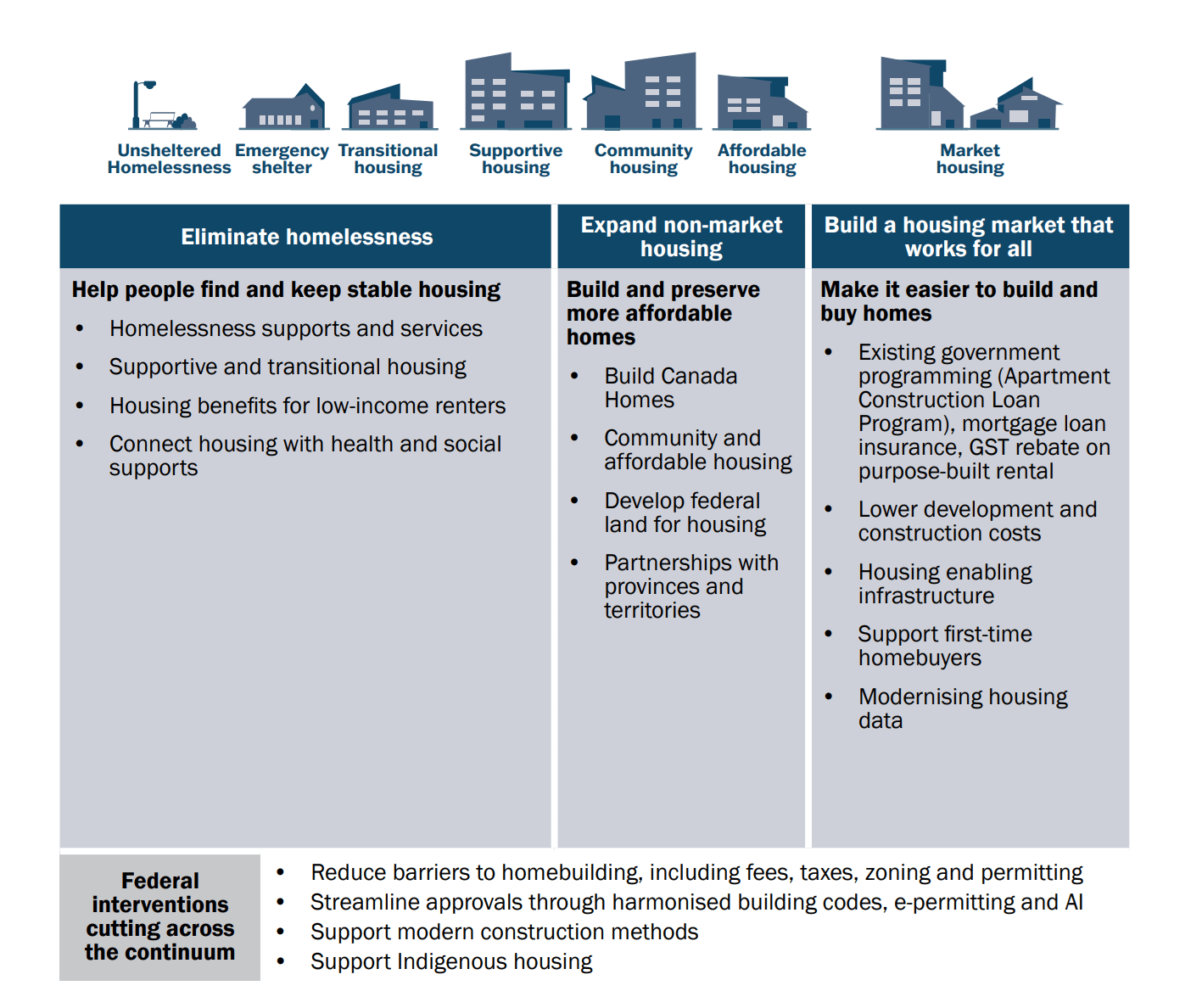
To avoid this problem of disconnected policies, in Budget 2026 the federal government has created a three-pillar, one-foundation framework to ensure housing-policy coherence. The pillars cover eliminating homelessness, expanding non-market housing options, and enhancing market-housing affordability, while the foundation includes measures to make sure the system as a whole works well. After all, market-housing and non-market housing use the same pool of labour to build, are subject to the same zoning code, and use the same sewer pipes. Too often, market and non-market housing are seen as policy-competitors, despite substantial policy overlap.
Figure 1: The federal government’s three-pillar, one-foundation housing strategy framework
Source: Budget 2026.
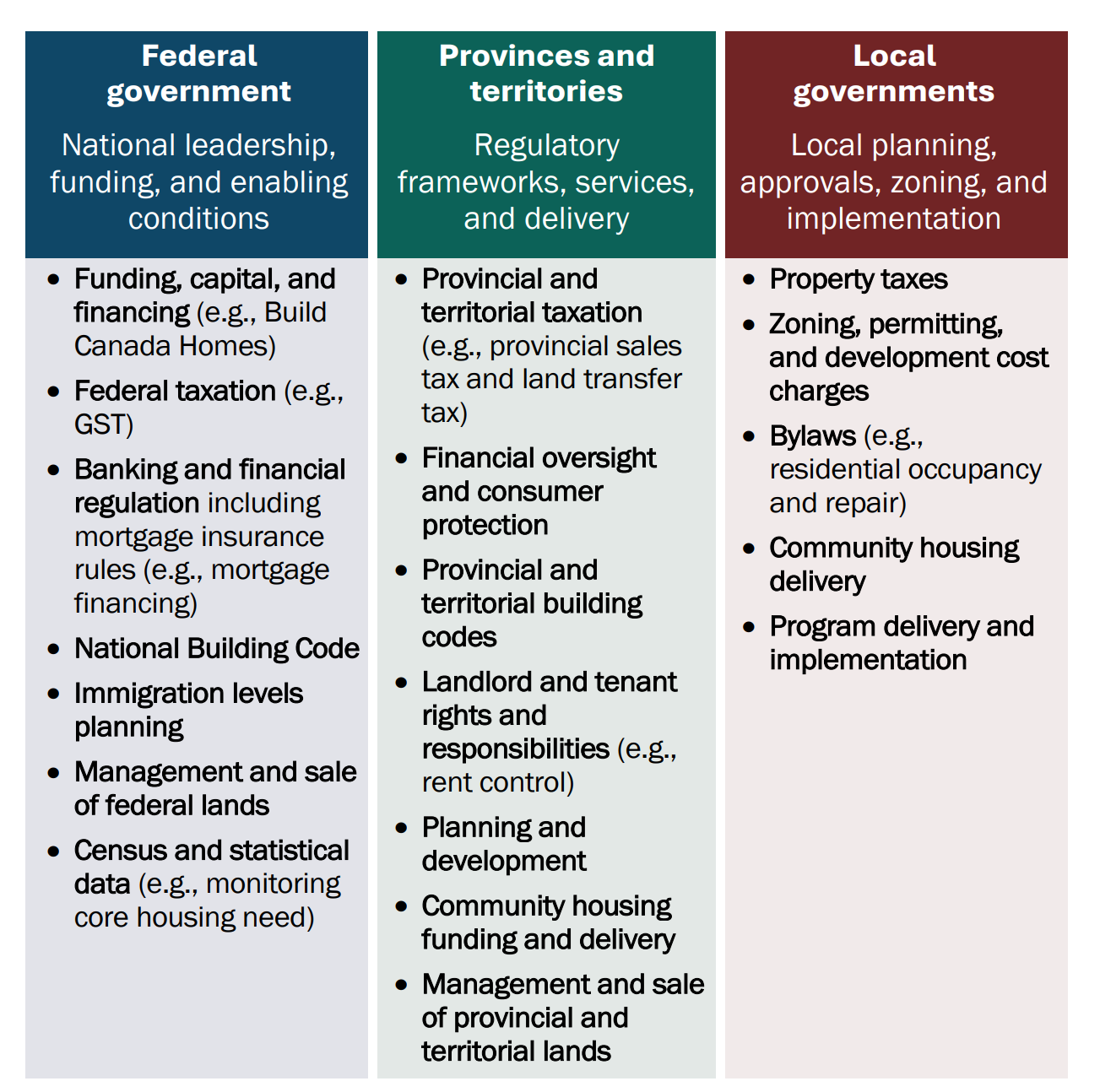
The 2017 National Housing Strategy ten-year strategy is soon to expire, and will need to be replaced by a new strategy or approach. This three-pillar, one-foundation framework should act as the guiding vision for the strategy. While we do not know what will be in that strategy, the specific bullet points in Figure 1 provide insights on the government’s priority, as does a follow-up chart which outlines the responsibility of Canada’s three orders of government when it comes to housing.
Figure 2: Government housing responsibilities by order of government
Source: Budget 2026.
There are several points that these two figures reveal about the Carney government’s thinking when it comes to the future of housing policy, including the following five:
The need to lower the cost-of-delivery and accelerate approval speeds. We have spoken about these at great length at MMI (the Prime Minister himself jokingly referred to our “incessant” discussion of these points). The government, apparently, agrees, as it mentions taxation, lowering development and construction costs, and streamlining approvals as priorities.
The need for better data. It is mentioned in both Figures 1 and 2 as important to addressing the housing crisis. From a lack of information on development charges, to the over-reliance of lagged housing-starts data as a real-time indicator of conditions, Canada’s housing data is in real need of modernization.
The need for housing-enabling infrastructure. Homes need sewers, water, and electricity to function, and the residents of those homes need schools, and roads, and parks. This requires a substantial amount of capital, but it also requires that Canada find ways to get more homes, and more families, to areas where infrastructure is well under capacity. After all, the cheapest piece of infrastructure is the one you don’t need to build.
The need for regulatory modernization. Poorly designed elements of zoning rules, the building code, and other regulations may act as barriers to creating the type of homes and neighbourhoods that work for Canadians, and disharmonized rules create barriers for modern methods of construction, a clear priority of the federal government. This framework plants a flag that regulatory modernization and harmonization will be a core part of the federal government’s housing approach going forward.
The need for more capital. RBC has highlighted the $2 trillion in capital needed to build the homes and housing-enabling infrastructure needed to address Canada’s housing shortage. Figure 1 mentions capital programs such as the Apartment Construction Loan Program and the need for housing-enabling infrastructure, while Figure 2 refers to capital, banking, and financial regulation. Expect these areas to be at the forefront of a future housing strategy.
This new framework should be carefully studied by housing-related groups across the country, including the Homes and Growth Coalition, which you will be hearing more from tomorrow.