


Highlights
Canada’s drop in homeownership has been caused by a multitude of factors. One that does not receive enough attention is how Canada has shifted away from building housing types that are typically owner-occupied and toward housing types that are overwhelmingly rental.
If we want to restore homeownership opportunities for younger Canadians, we need policies that make it easier to build ownership-oriented housing, whether that’s single-detached homes, semis, and townhouses, or reforms that allow multiplex and low-rise apartment units to be built and sold individually at lower cost.
Some homes are more likely to be owner-occupied than others
Canadians, particularly younger Canadians, have been in free-fall since 2011. There are many reasons for this, including rapid population growth. However, one factor that does not receive enough attention is the change in the types of homes built in Canada.
Homeownership rates in free fall
The homeownership data tell a dramatic story: homeownership rates declined sharply in Canada between Census 2011 and Census 2021, as outlined in our January 2026 report, A Blueprint to Restore Homeownership for Young Canadians. The decline for Canadians aged 25-29 was particularly sharp, falling from 44.1% to 36.5%, a fall of 7.6 percentage points, as shown in Figure 1.
Figure 1: Change in homeownership rate in Canada, in percentage points, by age, 2011-21
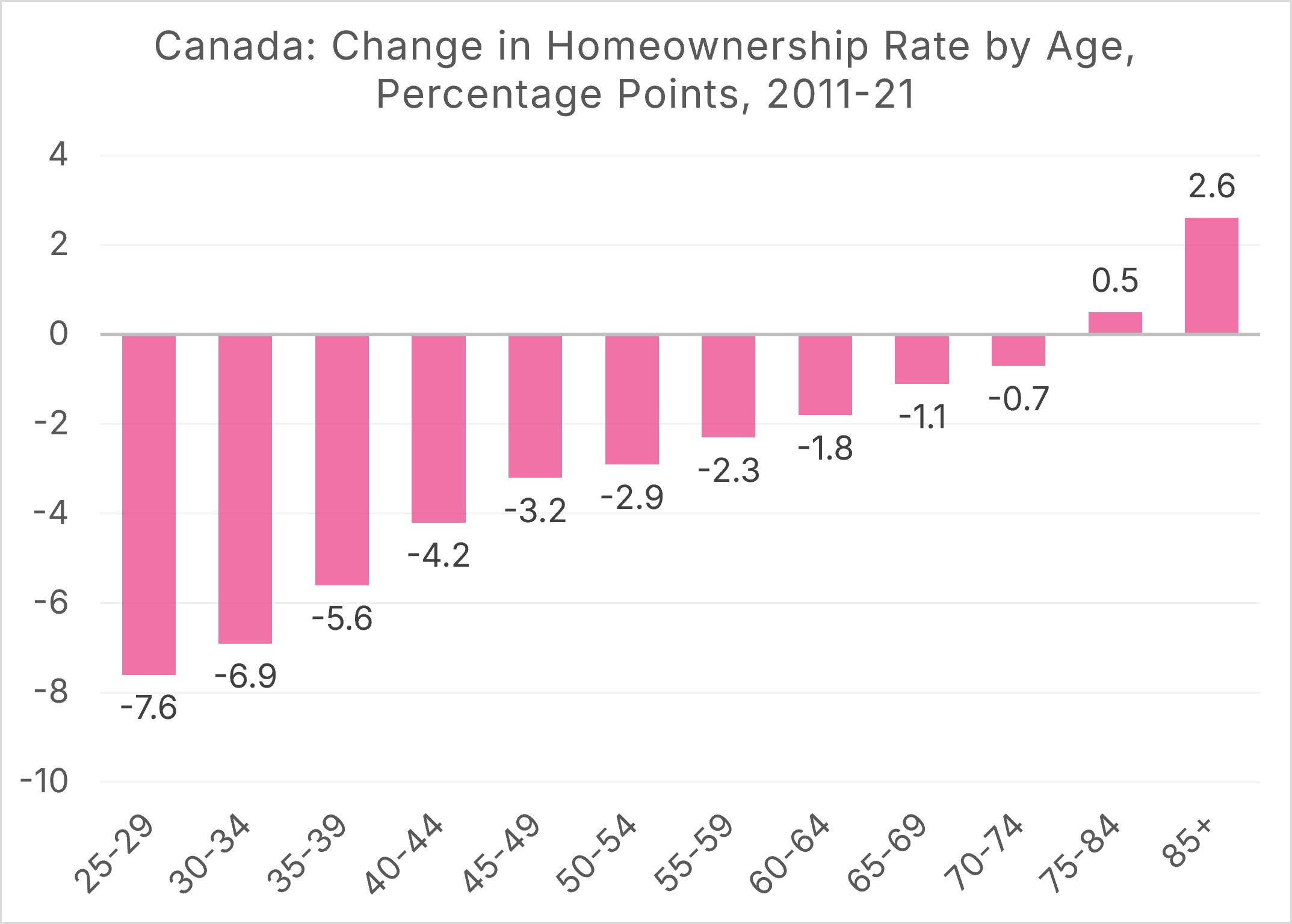
Chart Source: A Blueprint to Restore Homeownership for Young Canadians.
The relationship between ownership rates and housing types
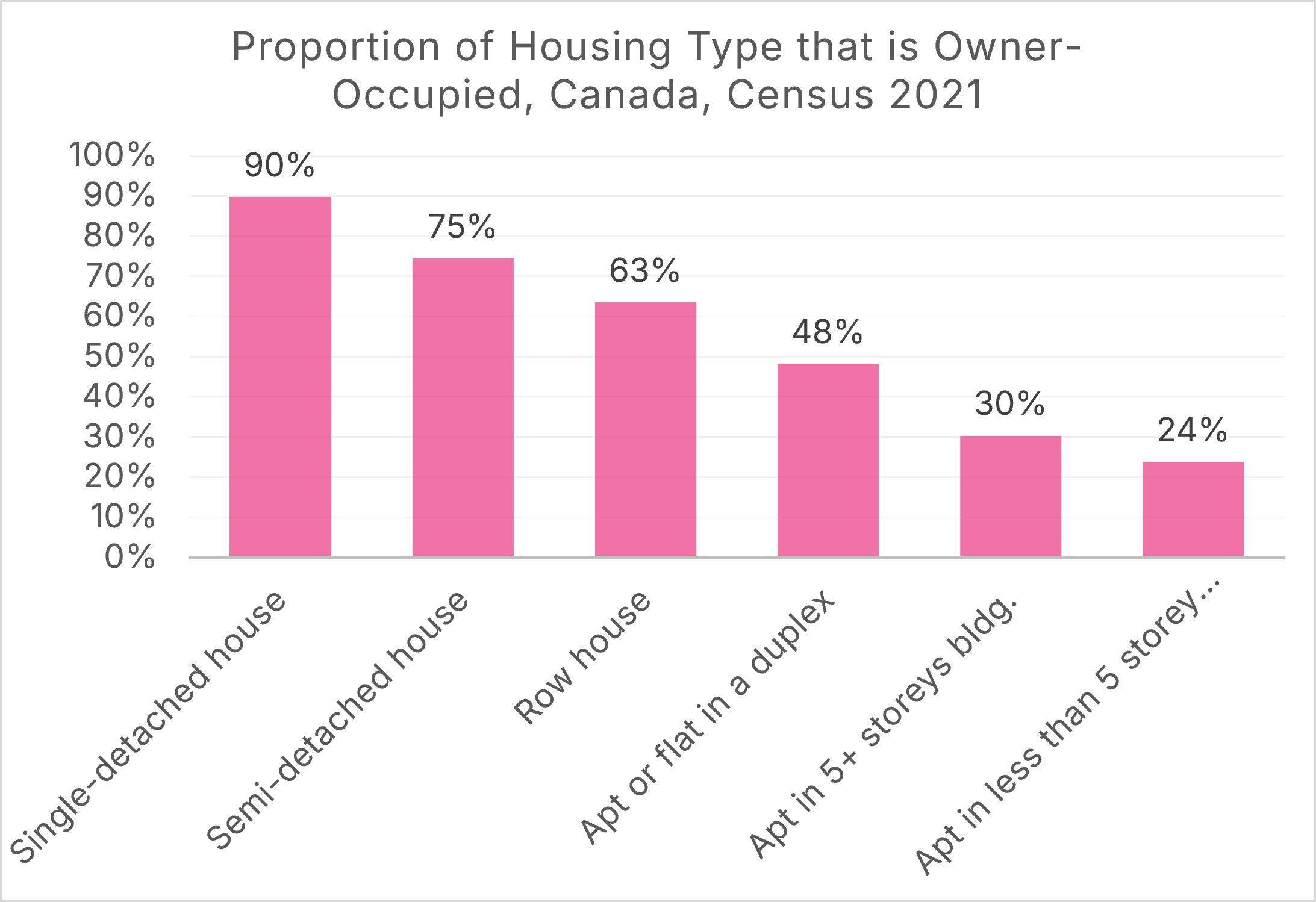
Certain types of homes lend themselves better to ownership. The vast majority of single-detached homes, as well as semi-detached homes and townhouses (row homes), are owned by their occupants. As shown in Figure 2, as of Census 2021, 9 out of 10 occupied single-detached homes are owner-occupied, with the rest being used as rentals, including student rentals. The data in Figure 2 is based on how the homes are actually used, not on whether or not they are purpose-built rentals.
The same does not hold true for units in apartment buildings, where the majority are rented out. Apartment units in low-rise buildings (fewer than 5 storeys tall) are most likely to be rented. In most places in Canada, for individual apartment units and units in a multiplex to be owned by occupants, ownership must be structured as a condo. In our report “From Cornerstone to Capstone: Building Canada’s Missing Middle Gentle-Density Housing”, we outline how this is prohibitively expensive in most cases, leaving rental as the only option. This is, however, a solvable problem, and the report provides recommendations on how to do so.
Figure 2: Proportion of housing type that is owner-occupied (for housing types exceeding 500,000 total units), Canada, Census 2021.
Data source: Statistics Canada Table 98-10-0233-01. Chart Source: MMI.
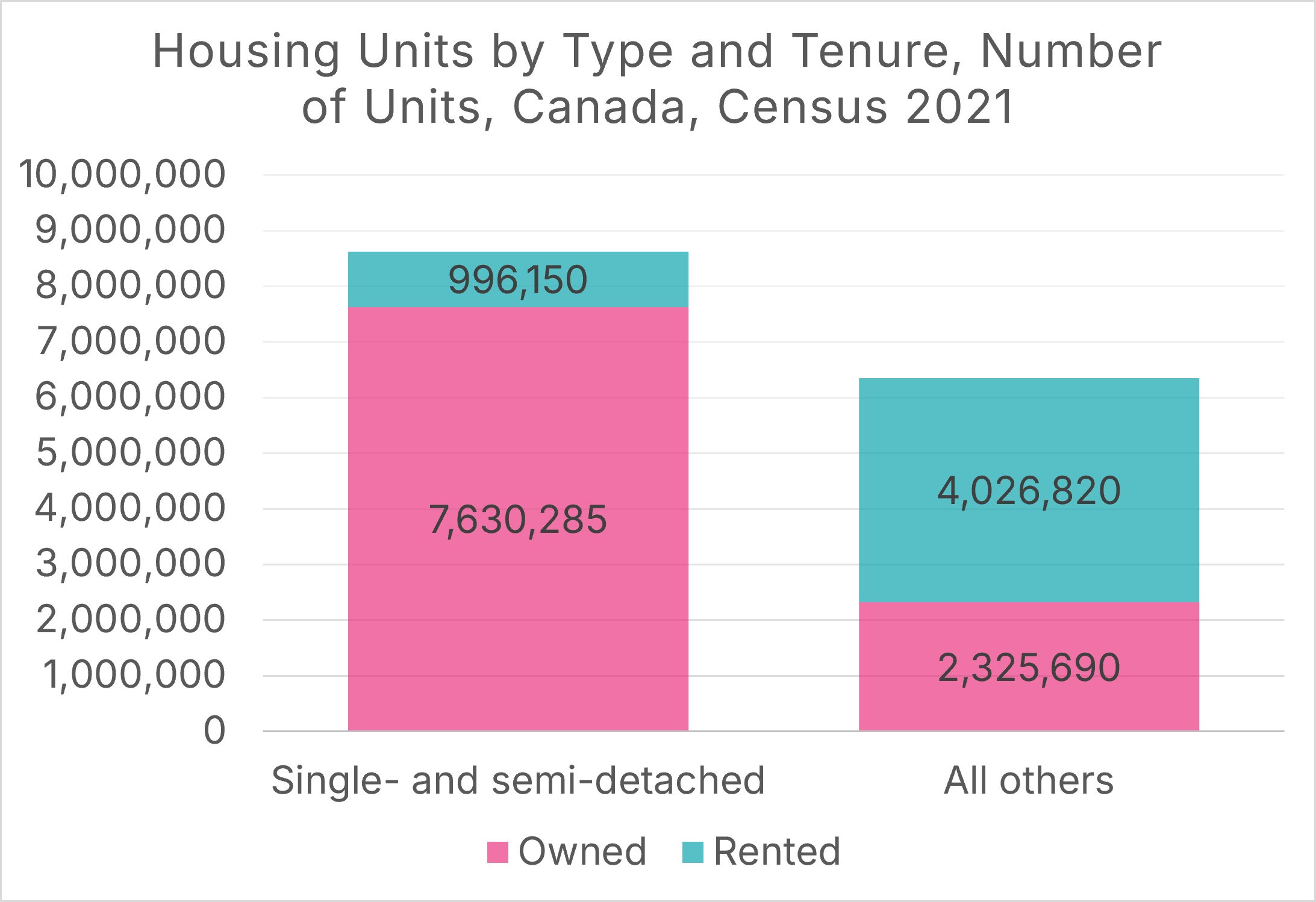
We can combine the two housing types with ownership rates over 75% (single- and semi-detached) into a single category, and place all other housing types in the other category. Figure 3 reveals that under such a division, the first category has nearly 90% ownership, while the second category has roughly 35%. Of the 10 million owner-occupied homes in Canada in 2021, over three-quarters of them were single- and semi-detached homes.
Figure 3: Total number of housing units by type and tenure, Canada, Census 2021
Data source: Statistics Canada Table 98-10-0233-01. Chart Source: MMI.
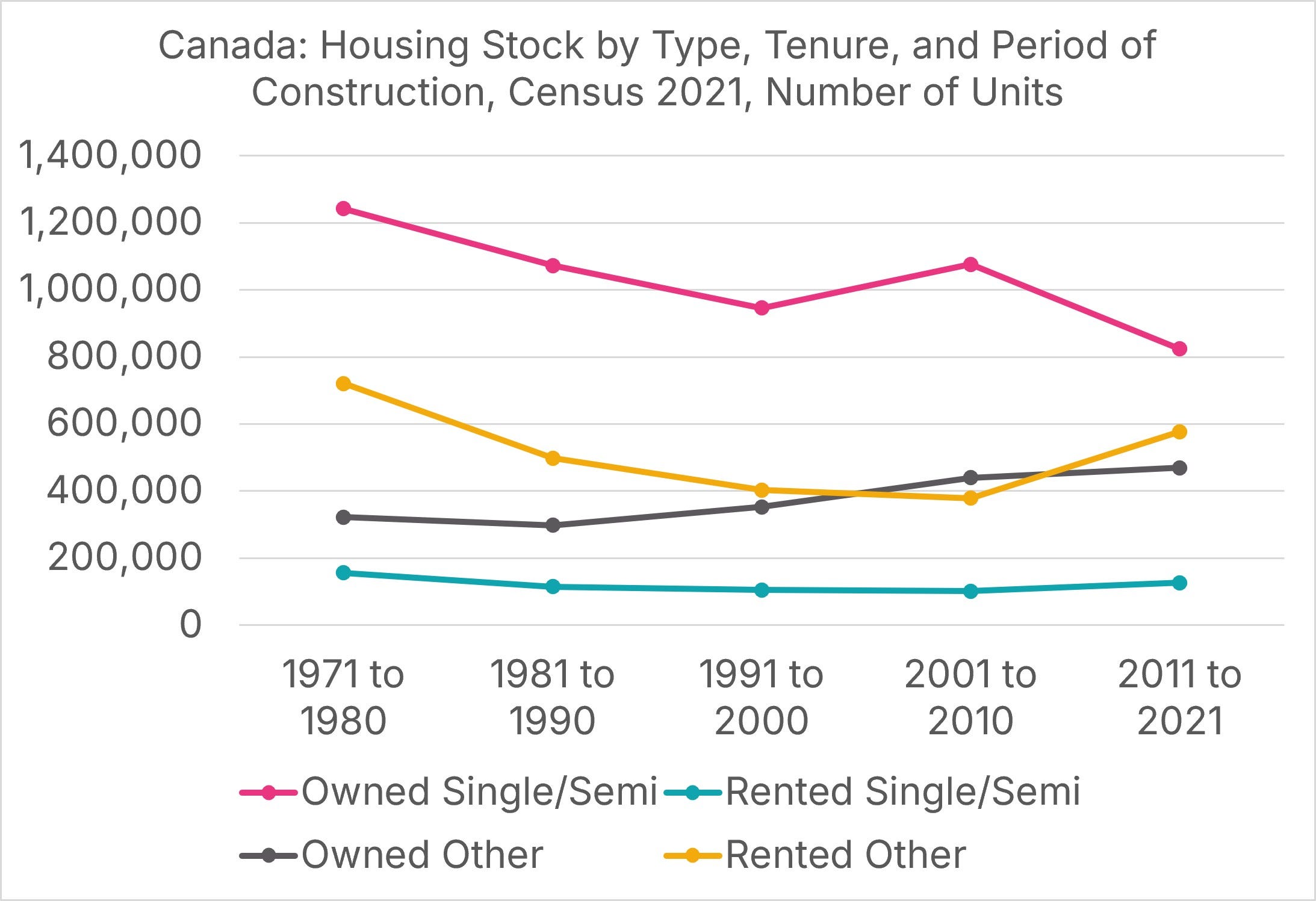
Using data from Census 2021, we can break down our housing data by unit type, use (rental vs. ownership), and construction period, as shown in Figure 4. Relative to 2001-10, a large number of “other” units (mostly apartments) were built from 2011-21 and used as rentals. This includes both purpose-built rentals and newly constructed condo units that were being rented out. As of 2021, there were slightly more rented single/semi-detached and owned “other” homes built in 2011-21 than in 2001-11. But this does not make up for the over-250,000-unit drop in owner-occupied single- and semi-detached homes built in 2011-21 relative to 2001-10.
Figure 4: Number of housing units by type, tenure, and period of construction, homes built after 1970, Census 2021
Data source: Statistics Canada Table 98-10-0233-01. Chart Source: MMI.
In the 2010s, Canada needed more rental apartment units to make up for four decades of relatively low construction. We still need more today. But we also need many more family-sized homes that families can own. That will require either reforms to make it less expensive and easier to build single-detached, semi-detached, and townhomes, or reforms to make it less expensive and easier to build multiplexes and small apartment buildings, coupled with regulatory reforms to allow units to be sold individually rather than just rented.