

Our Guiding North Star
The Missing Middle Initiative, housed at the University of Ottawa’s Institute of the Environment, seeks to revive Canada’s urban middle class. Our mission, which we call our North Star, is as follows:
Missing Middle Initiative’s North Star: A Canada where every middle-class individual or family, in every city, has a high-quality of life and access to both market-rate rental and market-rate ownership housing options that are affordable, adequate, suitable, resilient, and climate-friendly.
This North Star is densely packed with terms that require definition. Here is how we define each term, and why we have included each one in our North Star.
Defining our Terms
Middle-class: To help the middle-class, we must have some idea of who they are. There are many competing definitions of the middle class. For example, the Pew Research Centre defines it as families with incomes between two-thirds and double the median family income. More nuanced definitions consider factors such as age, wealth, and the local cost of living, as in this one from the Washington Post. Another income-based definition is provided by the Brookings Institution, which defines it as families in the middle 60-percent of the income distribution. In 2022, this definition would include Canadian families with incomes between $52,700 and $144,300. If using a strictly income-based definition, our preference would exclude the bottom 20 percent and top 10 percent of the income distribution, defining the Canadian middle-class family as being one with an income between $52,700 and $279,300.
High-quality of life: What we ultimately want for the young, urban, middle-class. This concept is even more nebulous and difficult to define than middle-class, but it is vital we have some notion of what success looks like. A number of organizations have attempted to define and measure the quality of life in our cities; the federal government also has a quality of life framework with 84 different quality-of-life indicators. Another indicator is the World Happiness Index, where Canada currently ranks 58th in happiness for adults under the age of 30. We should aspire to be #1.
Market-rate: Here we use the National League of Cities’ definition of market-rate housing: “Market-rate housing refers to non-subsidized properties that are rented or owned by those who pay market-rate rents or who paid market value to purchase the property. Unlike subsidized affordable housing, market-rate housing does not confer special government benefits.” We believe non-market housing, such as social housing, play a vital, and irreplaceable role in our housing ecosystem, and we need more of it, particularly for low-income families. We also recognize that this will not always be available for middle-class individuals and families, so they must have access to market-rate housing options.
Rental and ownership housing options: This should not be taken to mean that renting is preferrable to owning, or vice versa. Rather it is that the middle-class should not be locked-out of either option, and should be able to choose what best meets their needs. In a very real sense, freedom is a function of a person’s options, and being priced out limit’s one freedom and well-being.
Affordable: We have adopted the 30% of income threshold, which is part of the federal government’s definition of core housing need, as our definition for affordability: “Affordable housing costs less than 30% of before-tax household income. For renters, shelter costs include, as applicable, rent and payments for electricity, fuel, water and other municipal services. For owners, shelter costs include, as applicable, mortgage payments (principal and interest), property taxes, condominium fees, and payments for electricity, fuel, water and other municipal services.” We believe that middle-class individual families should be able to access market-rate rental and market-rate ownership housing options that have all-in shelter costs under 30% of pre-tax incomes. Families could choose to spend more, if they wish, but they should have options that are affordable (by this definition), adequate, suitable, resilient, and climate-friendly in every city in Canada.
Adequate: The definition of adequate also comes from the criteria for core housing need, and is defined as “housing [that] does not require any major repairs, according to residents. Major repairs include those to defective plumbing or electrical wiring, or structural repairs to walls, floors or ceilings.” We believe this is self-evidently important.
Suitable: This is defined by Canada’s National Occupancy Standard, but can be roughly thought of as any house that has enough bedrooms given the size and composition of the family. More specifically, the home should have enough bedrooms to allow for the following:
A maximum of 2 persons per bedroom.
Household members, of any age, living as part of a married or common-law couple share a bedroom with their spouse or common-law partner.
Lone parents, of any age, have a separate bedroom from their children.
Household members aged 18 or over have a separate bedroom, except those living as part of a married or common-law couple.
Household members under 18 years of age of the same sex may share a bedroom, except lone parents and those living as part of a married or common-law couple.
Household members under 5 years of age of the opposite sex may share a bedroom if doing so would reduce the number of required bedrooms. This situation would arise only in households with an odd number of males under 18, and odd number of females under 18 and at least one female and one male under the age of 5.
This condition is particularly important for our largest cities, as there is a real lack of homes that are suitable for families with children, by this definition. For example, between 2016 and 2021, the number of occupied private dwellings (a.k.a. homes) in the City of Toronto increased by nearly 48,000, but the number of homes with 3 or more bedrooms increased by less than 2,600. Over 94% of all the net new housing stock in the city had 2 or fewer bedrooms and, as such, would not be suitable for many families with children.
Resilient: Homes should be built in the right way, and the right places, to protect occupants from severe weather events such as flooding and wildfires, one of the four goals of the Blueprint for More and Better Housing. Homes that are not resilient put the occupants and their possessions at risk, and reduce affordability through higher insurance costs. Furthermore, the most expensive home is the one that you must build twice.
Climate-friendly: The Blueprint for More and Better Housing had the goal to “reduce Canada’s housing-related emissions to meet Canada’s 2030 climate targets”. This is a reasonable definition of climate-friendly, noting that housing-related emissions covers everything from the emissions used to heat and cool the home to transportation-related emissions related to travelling from home to work, school, or shop. Canada must find a way to create market-rate rental and market-rate ownership housing options that are affordable, adequate, suitable and resilient, while also ensuring that in building those homes, Canada can still meet its greenhouse gas emission targets.
Every city in Canada: Our cities will only thrive if they have a strong middle-class. The commonly-heard refrain “if people can’t afford to live in Toronto, they should move somewhere else” may seem sensible at the individual-level. However, at a societal level, we cannot have all the nurses live in Thunder Bay or Medicine Hat, and all the patients live in Toronto. It simply does not work. Our focus will be primarily on Canadian cities where the middle-class is being priced out. This is not just in the largest metros like Toronto and Vancouver, but is happening in mid-sized cities such as Halifax and London.
Examining our Choices
When we created the Missing Middle Initiative, we had to make a number of choices about who we would be and who we would not be, which included asking ourselves the following questions.
Why the name the Missing Middle Initiative?
Back in 2023, when we were naming our podcast, we landed on the name the Missing Middle because it had three different meanings, all of which felt appropriate for the topics we discuss:
The decline of the young, urban middle class in our cities — that is, the middle class has gone missing
The polarization of political discourse in Canada and how we seem to be losing the ability to collaborate. The middle ground is increasingly harder to find.
Missing middle housing in our cities
These three themes feel even more relevant today than they did in 2023.
As our founder, Mike Moffatt, is a proud Gen Xer, the name Missing Middle Initiative was also inspired by the Pearl Jam song Porch, specifically the lyrics:
All the bills go by, and
Initiatives are taken up
By the middle, there ain't gonna be any middle any more
Our goal is to ensure that there will continue to be a middle.
Why does Canada need a Missing Middle Initiative?
Canada has a crisis of youth happiness.
In the 2024 World Happiness Report, Canada ranked 58th among countries for adults under 30 in terms of happiness. For those aged 60 and above, we ranked 8th. The kids are not okay, and it’s not hard to see why. They’re increasingly being locked out of the urban middle class.
A generation of young adults believes they’ll never be able to enter the middle class, especially those living in metropolitan cities. Many cities risk losing their middle class altogether. The number of young people who think they’ll one day be able to afford a home — one of the traditional barometers of joining the Canadian middle class — is at an all-time low.
This generation faces a changing job market due to trends ranging from the advent of new technologies like ChatGPT to the reconfiguring of global supply chains. These trends provide this group with significant opportunities but also uncertainty. This is happening against a backdrop of other big global changes, from extreme climate change to geopolitical conflict.
What problem is MMI trying to solve?
The Initiative will focus on the issues and solutions needed to help young adults striving to join the middle class for the first time, ensuring the communities where they live remain accessible and inclusive. We believe that communities can’t be strong socially, economically or environmentally without a robust middle class. No community can be truly successful if the middle class cannot afford to raise children there, to live and thrive.
This concern is real. In the past decade, more people under 40 have been leaving Canada’s largest cities: Toronto, Vancouver and Montreal. We want to reverse this trend by helping a new generation of young Canadians join the middle class, ensuring cities remain vibrant and diverse.
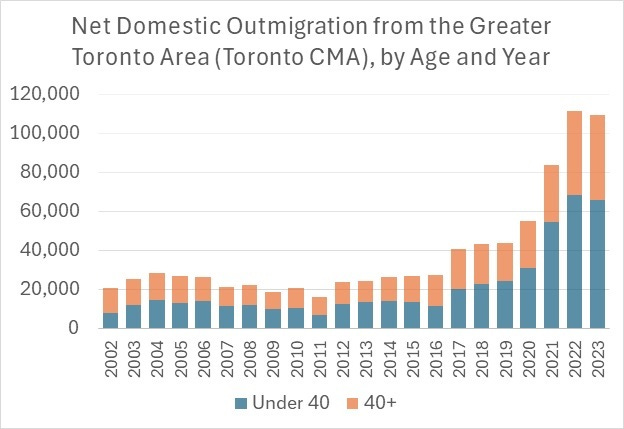
Source: Statistics Canada.
What does success look like for MMI?
To solve any problem, you need to understand it. You also need to have a vision of success. What would having a strong, young, urban middle class in Canada look like?
We are big believers in creating a vision of success — a North Star that can help guide one’s thinking and choices. For Canada’s young, urban middle class, our vision of success is as follows:
Missing Middle Initiative’s North Star: A Canada where every middle-class individual or family, in every city, has a high-quality of life and access to both market-rate rental and market-rate ownership housing options that are affordable, adequate, suitable, resilient, and climate-friendly.
Our cities will only thrive if they have a strong middle class. The commonly heard refrain, “if people can’t afford to live in Vancouver, they should move somewhere else,” may seem sensible at the individual level. However, at a societal level, we can’t have all nurses living in Nanaimo, B.C. or Medicine Hat, Alberta, and all patients living in Toronto. This would not work. We need the young middle class to thrive in any Canadian city.
How does the Missing Middle Initiative relate to clean growth?
The Missing Middle Initiative is housed at the University of Ottawa’s Institute of the Environment, and is aligned with our pre-MMI work to develop and promote innovative policies and market solutions to improve economic, environmental and social outcomes for Canada. As shown by a 2024 Abacus poll, young people are increasingly less likely than older Canadians to consider climate change and the environment a priority, as they have other, more immediate concerns, the top two being the rising cost of living and affordable housing; two of MMI’s focus areas.
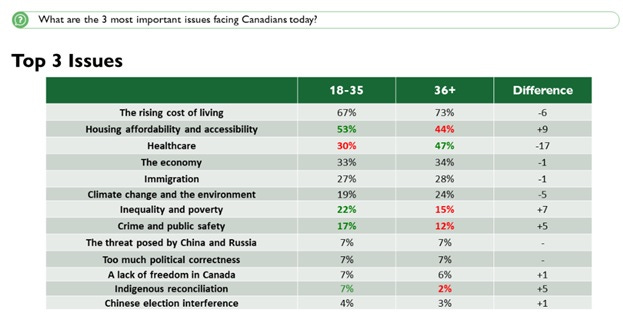
Source: Abacus.
The lack of attainable, climate-friendly housing in urban neighbourhoods near job opportunities is increasing the under-40s’ concern for affordability at the expense of their concern about the environment. The current housing crisis makes it harder for governments to enact nature and climate-friendly policies, particularly when environmental policies are seen as at odds with affordability. Only by ensuring that young adults can thrive in Canadian cities and join the middle class can we help fulfill SPI’s mission to advance practical policies and market solutions for a stronger, cleaner economy.
Why focus on the young, urban middle class? Why not prosperity more broadly? Why not focus on those most in need?
Canada has various economic challenges, and no one initiative can address them all. However, various organizations and think tanks, like the Smart Prosperity Institute, are dedicated to examining a subset of them.
There is a lack of organizations devoted to the current crisis impacting the young, urban middle class in Canada. This group’s challenges don’t often receive the attention they deserve. There is an understandable and justifiable tendency to want to shift the conversation to “What about the poor?”
Discussions of poverty are vitally important and must continue, and Canada has fantastic organizations dedicating themselves to that cause. There is a space to carve out a conversation focused on the urban middle class and the communities in which they live. In short, this initiative seeks to address a topic that’s often crowded out of the conversation.
Learn More about MMI
For more information on MMI, please refer to the following links:
About us: Who we are and why we exist.
Our mission: Details on the strong middle-class Canada we are trying to create.
Our strategy: How we will create a strong middle-class Canada
Our impact: Our success, to date, in creating a strong middle-class Canada.
Our team: The team working towards creating a strong middle-class Canada.
Support us: How you can help us create a strong middle-class Canada.
As well as our knowledge mobilization outlets, including:
Reports: A list of long-form studies and reports, including ones that predate the formation of MMI.
Podcast: Links to the Missing Middle podcast (available in both video and audio versions), video content, and our social media content.
Media: Links to MMI mentions in the mainstream media, along with guest pieces written by MMI staff in outlets from The Globe and Mail to The Toronto Star to The Hub.
Substack archive: An archive of our past Substack posts.