


Highlights
Despite recent declines in resale prices, home price-to-income ratios are double what they were in 2004, and in much of the country, incomes have not kept pace with rent growth over the past two decades.
The middle-class housing crisis leads many to ask, “What is the #1 thing that governments are getting wrong on middle-class housing?”
In MMI’s view, ineffective and often counterproductive housing policies stem from governments lacking a clear goal.
Targets like reaching 500,000 housing starts per year aren’t goals. They are a means to an end, not an end in themselves. Young middle-class Canadians want a home they can afford, not for the country to hit an arbitrary start target.
Governments need to define a clear, housing goal for young, middle-class Canadians, which they can use as the basis for policy.
We would recommend the following housing goal for Canadian governments: A Canada where middle-class individuals in every city don’t have to choose between their career, their family, and their home. Young, middle-class families must have the financial capability to grow into a family of up to five members; be able to access affordable, sustainable, new, but basic, housing suitable for a household of that size, whether renting or owning; and maintain the financial security to have up to three children before age 40 in any community in the country. Governments must recognize this need and align economic, policy, and regulatory levers to achieve this goal.
You can’t fix a problem if you can’t define success
At MMI, we often get asked, “What is the #1 thing that governments are getting wrong on middle-class housing?” Our answer, somewhat surprisingly, isn’t directly about policy. Rather, we believe the #1 problem of middle-class policy is that governments have no idea what they’re trying to accomplish. They have not set a goal, and they don’t know what success looks like.
Governments set targets, but these targets are objectives, not goals. Increasing housing starts to 500,000 a year is a means to an end, not an end in and of itself. And even as an end, it is a pretty weak one. What type of homes? Where? At what price?
If I’m a young person, my concern is not how many housing starts Canada has in a year. It’s whether I’ll be able to afford one, in the community I wish to live in, and to start a family with children if I so choose.
What Canada needs is a middle-class housing goal, in the GOST Framework sense; a qualitative, long-term vision of success that guides decision-making. So let’s work on that.
Figure 1: GOST Framework
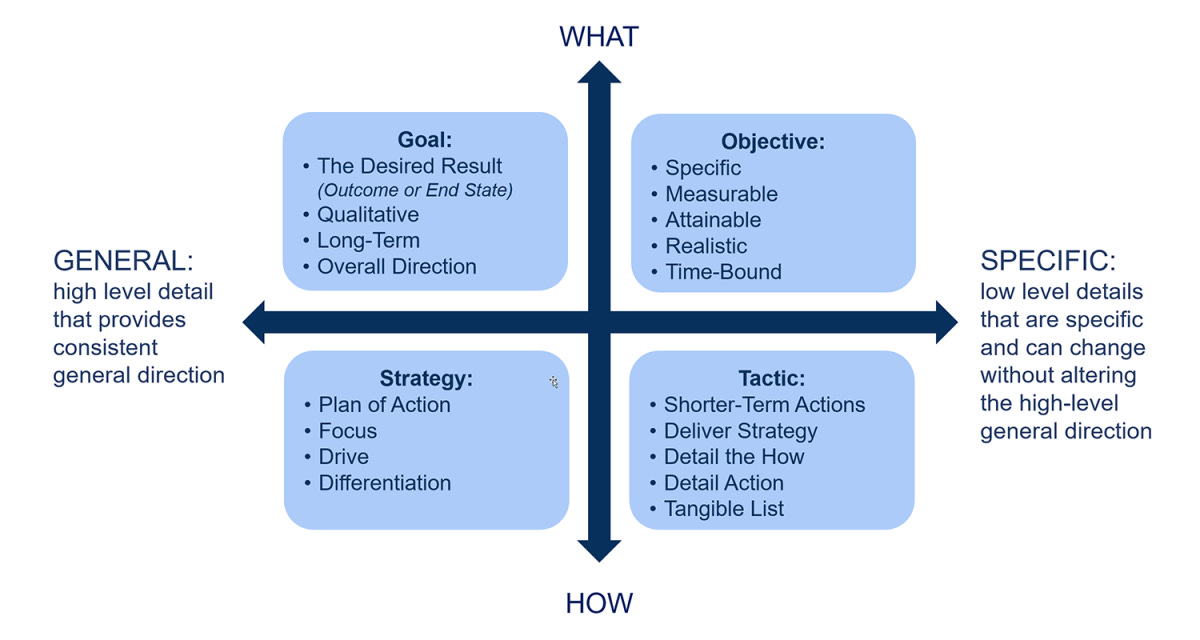
Source: Kent State University.
Creating a true middle-class housing goal for governments
We can start developing that goal by adapting the Missing Middle Initiative’s North Star:
Missing Middle Initiative’s North Star: A Canada where every middle-class individual or family, in every city, has a high-quality of life and access to both market-rate rental and market-rate ownership housing options that are affordable, adequate, suitable, resilient, and climate-friendly.
We define each of the terms in our North Star, such as “high-quality of life” and “middle-class,” here.
This North Star works for MMI’s purposes, but it would be a bit vague as a goal for Canadian governments to create housing affordability for young, middle-class Canadians. We can correct that with a few additions and some rewording, as shown below:
Young Middle-Class Housing Policy Goal: A Canada where middle-class individuals in every city don’t have to choose between their career, their family, and their home. Young, middle-class families must have the financial capability to grow into a family of up to five members; be able to access affordable, sustainable, new, but basic, housing suitable for a household of that size, whether renting or owning; and maintain the financial security to have up to three children before age 40 in any community in the country. Governments must recognize this need and align economic, policy, and regulatory levers to achieve this goal.
The ten principles behind a young, middle-class housing policy goal
We’re not convinced this is the best possible construction of the goal; there are undoubtedly tweaks that would improve it. However, each word was carefully chosen and is based on ten principles.
Middle-class housing policy should be centred around freedom of choice. It is not about telling middle-class people how to live or whether they should have (or not have) children, but rather about not being priced out of options that previous generations could take for granted. This includes:
Young, middle-class people should be able to afford to live on their own and start a family if they wish.
Young middle-class people, or couples, should not be priced out of their community, nor should they be blocked from moving to one because of housing costs.
Young middle-class people should have a range of entry-level rental and ownership options, not be limited to either ownership housing or rental housing. Both play a vital role in our housing ecosystem.
Young middle-class people should have the economic means to start a family and have children.
Time is of the essence. A target to solve the middle-class housing crisis 20 or 30 years from now does little for the 29-year-old who wants a home to raise children. Due to this, the North Star focuses on those under 40; we would advise governments to also have measurable objectives for those in their 20s and 30s.
Children are disproportionately impacted by the middle-class housing crisis and should be prioritized. The North Star also recognizes that children under the age of 6 and between the ages of 6 and 17 are more likely to live in unsuitably small housing (16.2% and 15.0% living in homes that are unsuitably small, respectively) than adults between the ages of 55 and 64 (4.7%) and those over 65 and older (2.8%).
The goal of middle-class housing policy should not be whether a middle-class person or couple can afford their current circumstances, but rather whether they can afford to move to a new city or have another child. This is a restatement of the first principle around choice, but it acknowledges that statistics such as core housing need estimate whether a family, as it exists today, can afford to have its housing needs met in the community where it currently lives. It says nothing about whether they can move, nor does it estimate whether they can afford another child. However, research shows that housing affordability constraints reduce family size, as many families sensibly opt not to have children they cannot afford. Our goals should not just ask whether a family can afford its current circumstances, but also whether it could move to another city or have another child.
Families come in all shapes and sizes, and the goal should reflect that, while also recognizing that benchmarks require bounds. Families come in all shapes and sizes, from nuclear families to multigenerational families to blended families to single-parent families and single individuals. Very few families are average; we have yet to meet a family with 1.5 children. Our policies must recognize this.
However, we also must recognize that for a goal to have meaning, it must be bounded. It cannot cover every possible circumstance. Currently, 97% of all households have five or fewer members, though the proportion of households with six or more members has increased in recent years. Basing an affordability goal on a five-person household feels reasonable, and covers many multigenerational families, though a more ambitious government could set the benchmark at six.
As of the 2021 Census, there were nearly one million families in Canada with three or more children. Three feels like a reasonable cut-off for our goal; unfortunately, no data is provided on how many families have four or more children.
To be clear, none of this suggests that families cannot, or should not, have more than five members or more than three children, and policymakers and urban planners should consider these families in their work. Rather, it is a recognition that achieving affordability for this group, at middle-class incomes, would be exceedingly difficult.
The goal of middle-class housing policy should recognize that both higher incomes and lower home prices are both pathways to eliminating the affordability crisis. The middle-class affordability crisis is larger than home prices, and there are multiple pathways to align incomes with the cost of living. Both higher incomes and lower prices play a role, specifically:
Raising after-transfer, after-tax incomes for young, middle-class Canadians, which can happen through some combination of higher pre-tax incomes, lower taxes, and increased transfers, such as increased Canada child benefit payments.
Lowering monthly expenses for young, middle-class Canadians by either making goods and services, including housing, less expensive or by reducing the things families need to purchase. For example, making it easier to live in walkable neighbourhoods near transit can reduce monthly fuel expenditures.
The role of government is not to directly build middle-class homes, nor to set middle-class wages, but rather to set the underlying conditions for success while filling in the gaps. Social housing and deeply affordable housing have a vital role to play in our housing system, and those homes should go to those who need them most, who typically are not in the middle class. This principle recognizes that the role of government here is to set the policy conditions for success and let markets work, while filling in the gaps with programs, like the Canada Child Benefit.
The goal should focus on lowering the price of basic new housing, not resale. There is considerable resistance to the idea of governments enacting policies with a deliberate goal of lowering the price of existing homes, as it turns housing policy into a zero-sum game between existing homeowners and potential buyers. Instead, governments should focus on reducing the “cost of delivery” of new homes to create new housing options for everyone, from young persons to seniors, and let market conditions determine the price for resale homes. Of course, what happens in the new market will impact resale prices, but not in a straightforward way. For example, making it easier to build family-sized infill multiplexes in big cities would put downward pressure on home prices in smaller communities, as it would reduce “drive until you qualify” traffic, while at the same time raising land values in the neighbourhoods where those multiplexes would be built.
Success should be defined as a middle-class person being able to afford a basic new home that meets their current and potential future needs, not a luxury one. One criticism we often hear at MMI is that the core cause of the middle-class housing crisis is that young people’s expectations are too high. We vehemently disagree with this claim, but we do recognize that our affordability targets should not be based on average new home prices for a given type of home. Rather, they should be based on a basic, entry-level home. Of course, a family could spend more on a home if they have the means, but the goal should be that a middle-class family can purchase a new home that meets their needs, not any new home.
Circumstances can change unexpectedly, creating a need for financial security. Unexpected events happen, from a family expecting to add one child having twins, to needing to move to another city for work, to divorces, to disability, to having an older family member requiring care and moving in. All of these can add unexpected costs, so financial security is vital.
Turning a qualitative goal into policy and quantitative results
Goals, by their nature, are qualitative. They provide a vision of what an organization is trying to accomplish. If a government were to adopt the goal laid out in this piece, it would then have to work out the objectives, strategies, and tactics to make it happen, including setting quantitative measures for its performance.
Much of the work that we will be undertaking at MMI over the next year will be in developing those measures, objectives, strategies and tactics. But those will have to wait for another day!
Curious how you would define that “basic” home? Sq ft? Garage? AC? Number of bathrooms? Energy efficiency? Then talk to a few builders and see what it would cost to build one, excluding land and development charges. That should set a floor that we shouldn’t expect to beat, even if government throws in the land and waives dev charges.
If incomes (say) doubled, why would it be a good goal that household could just afford adequate housing? (And, making basic housing the goal for middle-income households doesn't do much for other people who should also be able to afford children.) Gives too much wiggle room for politicians who see the main goal of housing policy as preserving boomer assets, although admittedly major income growth is a stretch anyway.
I think it would be super useful to have measures of future housing need that take it for granted having children is a normal (if not universal) part of adulthood. But I don't think the issue with an adequacy-based approach to market housing is that the previous definition of adequacy was just a little too miserly. Housing should get better (or take less of incomes) over time! (Imagine if the government goal on GDP was a constant target at some defined-adequate level.) Focusing on cost-of-delivery makes sense, but if government policy is driving up the cost well beyond physical building costs that doesn't suddenly become desirable just because an average earner has an income that can support bare-minimum housing.