


Highlights
A strong first year of influence: In its first year, MMI established itself as a trusted voice on housing and middle-class policy, earning widespread media coverage, legislative testimony, and positive citations from leaders across the political spectrum, including the Prime Minister and the Leader of the Opposition.
Research translating into real policy movement: MMI analysis helped inform tangible reforms in 2025, including development-charge reductions and deferrals, streamlined zoning in cities like Ottawa, BC’s commitment to legalize single-egress apartments, and the federal government’s decision to create a framework for stablecoin payments. However, MMI remains frustrated at the slow pace of change and will be doubling down on its efforts.
Rapid growth in reach and engagement: MMI published 177 Substack pieces with more than 650,000 reads, released 10 research reports cited by legislatures and major media outlets, and significantly expanded its podcast, video, and social-media audiences across Canada.
Credibility built where it matters most: MMI’s work was cited in federal and provincial legislatures, referenced in hundreds of media stories, and used by journalists to question policymakers, signs that evidence-based ideas are shaping the national conversation.
Well-positioned for bigger impact in 2026: With a growing team, sustainable funding, and a clearer understanding of how change happens, MMI enters 2026 ready to convert influence into deeper reforms on development charges, GST rebates, and missing-middle housing supply.
Looking Back Before We Look Forward
The start of a new year is both a time to look forward and to reflect on the previous year. The Missing Middle Initiative was launched on January 20, 2025, so we are still less than one year old, but now seems as good a time as any to review what we did, and what we failed to do, in 2025.
As we outline in our Strategy page, MMI Bressan and Hoxtell’s linear model of change to assess and analyze our performance, which contains six key indicators.
Figure 1: Linear Theory of Change Model with Linear Indicators
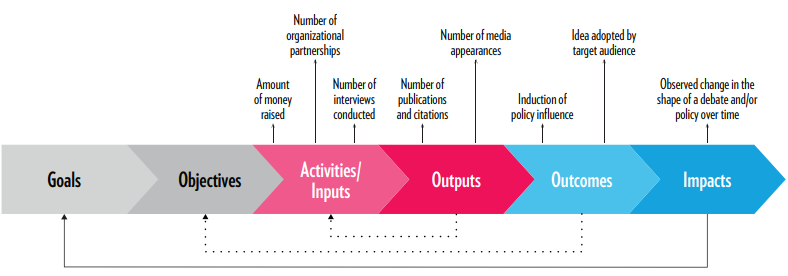
Source: Whose Bright Idea Was That? How Think Tanks Measure Their Effectiveness and Impact
In this Year in Review, we will examine our 2025 performance on three of these indicators in reverse order.
Outcomes and Impacts
As we noted in our Impact section, we were disappointed at the modest level of reforms enacted by governments in 2025, though we were pleased that the federal government has committed to creating a framework for the use of stablecoins in payments. This reform was part of Budget 2025, and came less than two months after our research report made a similar recommendation.
There were other wins, including a number of municipalities lowering development charges, Ontario allowing development-charge deferrals, streamlined zoning reforms in cities such as Ottawa, and commitments in British Columbia to legalize small single-egress apartment buildings. Overall, it is a smaller list than in 2023 and 2024, when MMIs predecessor was instrumental in having the federal government eliminate the GST on purpose-built rental construction, along with a suite of other housing reforms.
We have an extensive wish list of housing and non-housing policy reforms we will work towards in 2026, including substantive development-charge reforms, enhanced GST rebates for new homes, and the reintroduction of the 1970s-era MURB provision to facilitate the construction of small- and mid-rise apartments. (The full housing policy wish list is found in the article Our 2026 Housing Policy Wish List: Ten Ways to Fix the Crisis)
One key measure of “outcomes” is testimonials. In 2025, MMI was cited positively by both the Prime Minister and the Leader of the Opposition, as well as other politicians across the political spectrum.
Figure 2: Cited by the Prime Minister
Figure 3: Cited by the Leader of the Opposition
Outputs
Although we did not see policy reforms go as far as we would have liked, it was not due to a lack of exposure. Our ideas and output received considerable attention, and MMI testified before both House of Commons and Senate committees in 2025 on middle-class-related matters.
Our outputs were spread across various forms of media, including the following:
Substack: MMI published 177 separate pieces in 2025 on our Substack in 2025, including podcast transcripts. Our most popular pieces in 2025 can be found in the piece Housing, Budgets, and One Angry Starbucks Post: Our Top Articles of 2025.
In total, our 177 pieces received over 650,000 reads, and we currently have over 3,500 subscribers. (And if you haven’t subscribed, what are you waiting for? It’s free!)
All of our Substack pieces can be found in our Archive.
Research Reports: MMI released 10 separate research reports, each cited at least once by a media outlet, such as our 2025 Provincial HOMES Report Card, which generated the headline Canada’s largest provinces score worst on housing policies and outcomes, report says.
Our Q3 2025 GTA and GGH Housing Report Card: Starts, Sales, and Employment was cited four times in federal Parliament and twice in the Ontario legislature; our Q2 2025 GTA and GGH Housing Report Card: Starts, Sales, and Employment was cited once in Parliament; and our Report Card on More and Better Housing was cited in the Ontario legislature. We were also cited by Saskatchewan Premier Scott Moe in Saskatchewan’s legislature during a debate on rent control.
The full list of MMI research reports is available in our Reports section.
Podcast, Video, and Social Media: The Missing Middle podcast, which predates MMI, had another successful year, with our 25 most popular episodes of all time featured in the piece The Episodes That Defined the Missing Middle Podcast (So Far).
A full list of our audio, video, and social media outlets is available at Podcast, Video, and Social Media. By the numbers, we have:
The audio version of our podcast currently has 141 episodes and over 236,000 downloads.
Our YouTube channel contains the video version of our podcast, along with short podcast clips and bonus video shorts not found on the podcast. It currently has 694,000 lifetime views, over 5,300 subscribers and 560 videos.
Our TikTok channel also features show clips and other bonus video content and currently has over 356,000 lifetime views across 367 shorts.
Two weeks ago, we started the Missing Middle subreddit r/missingmiddlers, which hosts active discussions of MMI content.
Mainstream Media: Our team wrote 14 opinion pieces that appeared in mainstream outlets; those pieces are available on our Opinion Pieces and Media Mentions page. They include eight pieces published in the Toronto Star, five in the Hub, and one in the Globe and Mail.
During the year, we made nearly 100 television and radio appearances, appeared at dozens of events, and had our work referenced or quoted in more than 400 mainstream media articles and videos. Our Founding Director, Mike Moffatt, made several appearances on national TV programs, such as CBC’s Power and Politics.
Figure 4: Mike Moffatt on CBC’s Power and Politics
Figure 5: Mike Moffatt on BNN Bloomberg
It was also not uncommon to see the media reference our work in questions to policymakers.
Figure 6: Federal Finance Minister Asked About MMI
Figure 7: Federal Housing Minister Asked About MMI
Mike also appeared on the highly watched Prof G podcast, with his appearance being seen over 120,000 times on YouTube alone.
Figure 8: Mike Moffatt on Prof G Markets
Activities and Inputs
When we founded MMI at the beginning of the year, we had three active full-time employees: Mike, Meredith Martin, and Jesse Helmer, with a fourth, Cara Stern, on parental leave. We also had Sabrina Maddeaux, who co-hosts the Missing Middle podcast in a freelance capacity.
Our team grew over the year, adding Alex Beheshti as a Senior Researcher. Cara came back from parental leave, and Sabrina graciously agreed to stay on in a freelance capacity.
Alex has since left the organization (we wish him the best!), but we’ve added veteran Digital Producer Sean Foreman to our team, bringing us up to 5 full-timers and one freelancer. The biographies of our team members are available on our Our Team page.
As far as our finances go, we set a goal to raise between $900,000 and $1 million for the year to ensure we could pay the bills. We have not finalized the numbers, but I am confident we will have hit our goal and will live to survive another year.
Fundraising is a necessary part of the job; MMI has no endowment and must pay for salaries and services used both inside and outside the University of Ottawa; therefore, it relies on Supporting Partners. MMI currently receives roughly half of its funding from charitable organizations and not-for-profit entities, with the remainder from government and private-sector partners.
In 2026, we plan to raise $1 million to support exciting plans for the coming year, which we’ll be announcing tomorrow.