


Earlier this week, we released The Episodes That Defined the Missing Middle Podcast, which grouped our 25 most-watched episodes into six categories and provided additional commentary.
The piece did surprisingly well, given that it was published on the week of Christmas, so clearly many of you are fans of “best of” pieces. In the same spirit, here is a list of our most-read Substack articles from 2025, along with additional commentary. We’re changing it up a little and examining our most-viewed piece for each month to see how our topics and audience have evolved. We’ve also included any piece that received over 5000 views as an honourable mention, if it was not the most-read piece that month.
Without further delay, the list!
January: The State of Development Charges in Ontario (2600 views)
By my count, MMI has published over 30 pieces this year related to development charges. You would think readers would want us to move on to something else (and I suspect many do); however, our pieces on DCs consistently perform among our highest.
February: In 2005, There Were 41 Communities Where a Middle-Class Family Could Afford to Buy a Home. Today, There’s Only Nine (9200 views)
We had several data deep dives early in the year on how middle-class housing affordability has deteriorated over time. Outside of a November piece examining affordability across the OECD, we haven’t been publishing much on this topic in recent months. That was probably a mistake, as this subject remains popular with readers.
Honourable mention:
When Did Middle-Class Housing Become Unaffordable? (6400 views)
March: Young Families are Leaving the GTA in Search of Family-Sized Homes (3600 views)
Most of our pieces in March were on development charges, which consistently performed well but not outstandingly. Our most viewed piece this month examined the outmigration of families from the GTA, a subject I’ve been writing about off-and-on since 2017.
April: Ten Thoughts on the Liberal Housing Plan (9400 views)
I had been in the media a fair bit in April, commenting on the federal election. On a whim, I took my interview talking points, turned them into a piece, and published them on a Friday. To our collective surprise, there was substantial interest in the piece. Two days later, we published a piece examining the Conservative housing plan.
Readers also seemed to enjoy our piece on housing affordability, which centred on my fact-checking of my co-host, Sabrina (spoiler: she passed the test).
Honourable mention:
May: The Impossible Trinity that Broke Canadian Housing (11,700 views)
I have a belief, which I’ve instituted at the Missing Middle, that you should take enough risks with content, whether it be podcast episodes or written pieces, that 5-10% of what you publish should perform significantly worse than the rest. If that proportion is under 5%, you’re not taking enough risk, and if it’s over 10%, you’ll annoy your audience. By aiming for 5-10%, you give yourself room to experiment and fail.
Of course, by definition, 10% of your content must be in the bottom 10%, but there should be a visible cliff in the 7-8% range between your regular content and stuff that fell off a cliff, either because of the topic, when it was published, a thumbnail image that didn’t land, or some other factor.
This piece was one of those experiments. I thought it wouldn’t do well because it was too wonky and weird, and that it simply wouldn’t resonate with people, but I figured it was worth a try. Instead, it became our first piece ever to crack 10,000 views.
Of course, many of the “experiments” we posted did, in fact, perform poorly. But it’s less fun to talk about those.
On the other hand, we thought our piece on taxes and Vancouver condo construction would perform well, and it did.
Honourable mention:
June: No 3-Bedroom Homes, No Kids, No Future: Why Families Are Leaving Cities (4900 views)
I really like the map on this one, though we had to enter the colours manually.

There is a way to get a map to fill in the colours in Excel automatically, but it ends up looking like this map from The Slow-Motion Exodus: How GTA Outmigration Became Ontario’s Defining Trend.
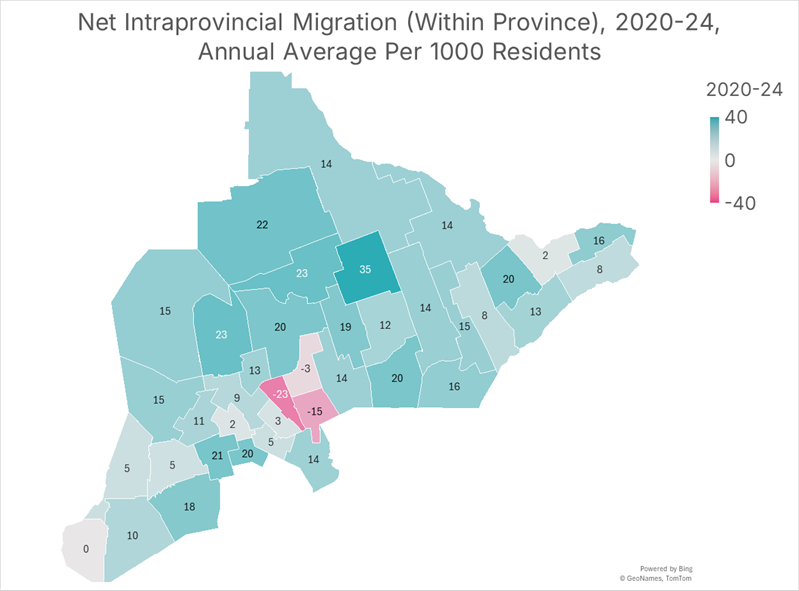
The borders of the various Census Divisions look lumpy and weird because Excel includes the maritime borders of each Census Division, not its land-based borders. Also, the idea that Chatham-Kent has a maritime border feels wrong; is there another term for it when referring to borders along the Great Lakes?
Anyhow, if anyone knows a fix for this in Excel, please let us know at [email protected], because we’re stumped.
July: The Quiet Death of the Investor Condo? MURBs May Change the Game (7200 views)
Much to my annoyance (which becomes abundantly clear in our top piece for November), the federal government left the proposed MURB (Multiple Unit Residential Building) tax provision out of Budget 2025 and has seemingly forgotten about their campaign promise from Election 2025. That would be a shame, because bringing it back is a good idea, as it is tailor-made to help finance multiplexes and small apartment blocks. There are several finicky details to get right, and a poorly-designed policy could fail in a number of ways, so let’s hope the federal government is simply taking their time to get MURB right, rather than abandoning the commitment altogether.
The honourable mention is one of my favourite pieces we released this year. We often hear well-meaning and legitimate concerns about how reducing development charges or the GST on new housing construction will deprive governments of much-needed revenue. However, we never hear the converse: that lower housing construction also has a fiscal cost. Every time a municipal government reduces the number of storeys in a high-rise, reduces the number of units in a building due to rules like angular planes, or ties up a potential project in red tape, it loses money.
Both action and inaction have a fiscal cost. The cost of inaction is particularly pernicious, as it both reduces government revenue and the number of homes available for rent or sale.
Honourable mention:
August: Solving the Housing Supply Crunch: A 10-Step Plan for Federal Action (5500 views)
This piece is the introduction to a background report we wrote for the Large Urban Centre Alliance, a group of 13 homebuilders that operate in Canada’s six largest metros. The recommendations hold up well; unfortunately, there has been very little movement on them.
September: Failing Grades, Falling Starts: Ontario Housing’s Bleak Mid-Year Checkup (5400 views)
This was the first of our quarterly report cards examining new housing starts and sales in the Greater Toronto Area and the Greater Golden Horseshoe. We would add more communities in Ontario, but unfortunately, we only have data for these regions.
We do, however, have enough data to do versions for British Columbia and Alberta. If you would like to see quarterly Alberta or B.C. versions of the report, please let us know!
October: From Vancouver to Montréal, Canada’s Housing Engine Is Stalling (4300 views)
October was a month that was heavy on reports and light on posts. Our most-read post of the month was on the decline in new housing sales in Canada’s largest markets, which was a clear theme in the second-half of 2026.
November: We Expected Little in the Federal Budget on Housing. We Got Less Than Expected (12,100 views)
I went to the stakeholder lock-up for Budget 2025, where various stakeholders get to see the budget hours before it’s released, but cannot leave and have no access to the outside world. Federal officials, from both the public service and Ministerial offices, are there to answer questions. The idea is that you have time to study the budget, write whatever you need to write, and once the Budget is released to the world, the internet comes back on, and you can instantly share your thoughts with the world. I have been to close to 20 federal budget lock-ups, and 7 or 8 provincial ones, though usually in the media lock-up, rather than the stakeholder one.
I got to the lock-up, spent 30 minutes going through the budget, and was disappointed to see how thin it was on housing. I asked several questions and shared my thoughts with officials, who disagreed with my take. After a fairly, uhh, spirited discussion (think Earl Weaver arguing with umpires, though taller and slightly less swearing), we agreed to disagree.
After the Budget was released and the internet came back on, I realized I had spent all my time arguing with officials and hadn’t actually written anything. I walked over to the Starbucks at 99 Bank, grabbed a coffee, and threw together a few thoughts which we posted on the Substack.
It quickly became our most-read piece (though it has since been eclipsed) and led to over two dozen media interviews, including an appearance on Power and Politics.
The point of the story is: Angrily procrastinating and cobbling something together at the last minute is a surefire recipe for success. I recommend it to everyone.
Our piece on Build Canada Homes also generated a fair bit of interest and was also critical of the federal government’s inaction.
Honourable mentions:
Build Canada Homes Just Got Clearer... And More Concerning (11,400 views)
The GTA’s Missing Middle: Not Just a Housing Type, but a Whole Generation of Families (6400 views)
December: What Happened to the Young Middle-Class Man? (15,900 views)
December was a busy month at MMI, and several of our pieces performed well. Our top performer of the year was our piece on young men’s incomes; one of our few non-housing pieces to crack the top-25. We’re planning to increase the volume of our non-housing content in 2026, as there is clearly an appetite for it.
The second quarterly GTA report card release makes our honourable mentions list, along with two pieces focused on the provinces. The first, our 2025 HOMES report card, examines policies and outcomes at the provincial level. The second, on how the Ontario government’s population projections “lock-in” housing shortages, is wonky, but important.
When it comes to our analysis of provincial housing policy, there were two big themes in 2025:
Complaints on social media that we don’t write enough about provincial inaction on housing.
Our pieces on provincial inaction performing far worse than our pieces on federal and municipal inaction, receiving fewer views and fewer social media shares.
In short, if you are one of those folks who want to see more pieces about the provinces, it would really help us out if you shared the ones from us (and others) that speak to you.
Honourable mentions:
The Big Collapse: New Condo Sales Down 89%, Ground-Oriented Down 65% (7000 views)
2025 Provincial HOMES Report Card (6200 views)
Planning Based on Yesterday Is How You Get Today’s Housing Crisis (5000 views)
Hope you all had a very Merry Christmas and are having a happy holiday!