


Highlights
It’s been a rare stretch where policy ideas are actually turning into policy action. We’re the first to admit attribution is murky, but 2026 has been a very good year for getting Missing Middle ideas adopted.
A big (and somewhat unexpected) win in this week’s federal Spring Economic Update: changes to CMHC programs to support triplexes and fourplexes. That’s a direct match with our recent recommendations and a meaningful step toward unlocking gentle density.
The Update also doubled down on areas we’ve been pushing for: scaling up low-cost rental construction loans, streamlining building codes, and improving housing data. None are headline-grabbers, but all matter.
These policy wins follow previously announced federal–Ontario measures on development charges and HST rebates, both of which were aligned with MMI recommendations.
On the MMI front, it’s been an unusually productive start to the year: four research reports, three new podcast series with 35 episodes to date, and multiple policy recommendations already reflected in government action.
Our content reach is growing quickly, including hundreds of thousands of views, strong podcast downloads, and an expanding mainstream media presence.
Our focus remains unchanged: to keep producing evidence-based research and practical policy ideas that make it easier to build housing for the middle class, and to keep pushing until governments act.
The Spring Economic Update and a very good year so far for MMI
One of the biggest challenges for policy-oriented think-tanks is that successes are few and far between. You can conduct the best research in the world, put out multiple reports, write dozens of op-eds, and make hundreds of media appearances, and nothing comes from it. You can go years without achieving any meaningful change, and when it does happen, you run into the attribution problem, where it’s impossible to know how much, if any, your efforts contributed to the change.
On the other hand, think-tanks can experience a run of policy wins, like MMI has had this year. We had thought the federal-Ontario deals on development charges and new housing rebates would be the extent of it, but this week’s 2026 Spring Economic Update gave us another item to add to our “MMI recommendation gets adopted by government” list. Though, as always, it is unclear how much we can take credit for it, if any, because of that pesky attribution challenge.
Anyhow, we thought we’d take this opportunity to examine what was in the federal government’s spring economic update, as well as provide our own update on MMI’s activities in the first four months of 2026.
An unexpected win in the Spring Economic Update
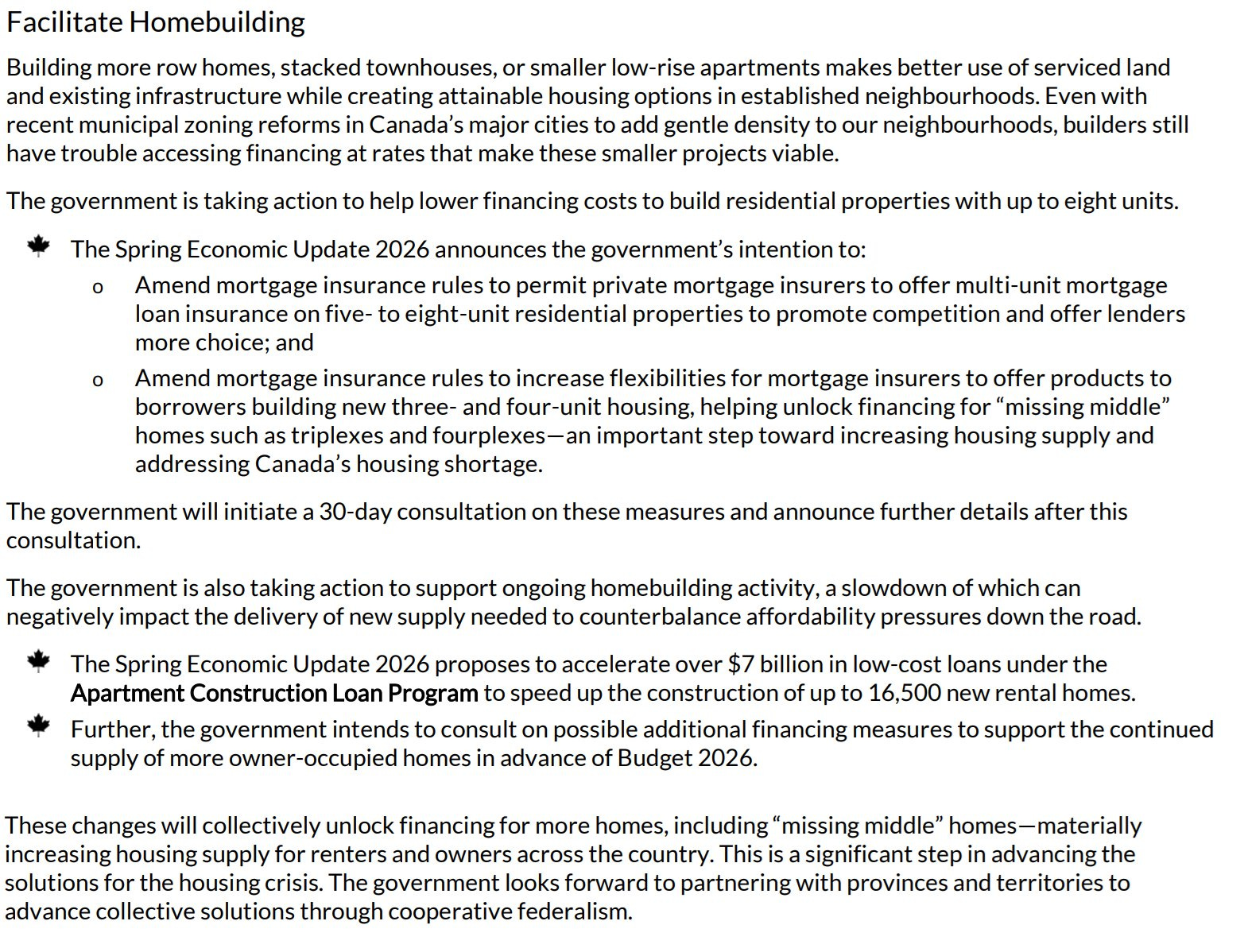
In any federal budget or economic update, there are always a number of smaller announcements that don’t make mainstream media headlines, but are important nonetheless. Page 98 of the Update included a series of them under the heading “Facilitate Homebuilding”:
Figure 1: Section from the federal 2026 Spring Economic Update
Source: 2026 Spring Economic Update.
The bullet point on allowing “mortgage insurers to offer products to borrowers building new three- and four-unit housing” sounded very familiar. In fact, it sounded a lot like our recommendation to “…increase the supply of missing middle housing, create an application stream in the CMHC’s Apartment Construction Loan Program (ACLP) for smaller builders who wish to build 2-4 unit buildings or require loans less than $1 million in size.” which appeared in both our January 2026 report A Blueprint to Restore Homeownership for Young Canadians (Recommendation 3) and our April 2026 report From Cornerstone to Capstone: Building Canada’s Missing Middle Gentle-Density Housing (Recommendation 11a).
However, we weren’t sure whether the federal government was specifically considering changes to CMHC programs like ACLP and MLI Select, or if it had something else in mind. We made a few calls and had it confirmed; there will be changes to CMHC programs that currently have a 5-unit minimum to open those programs up to triplexes and fourplexes, exactly what we recommended!
There were a few other initiatives in the update that are aligned with MMI’s past recommendations, including a commitment to “accelerate over $7 billion in low-cost loans under the Apartment Construction Loan Program to speed up the construction of up to 16,500 new rental homes” (aligned with recommendation #4 of The National Housing Accord), streamlining the National Model [Building] Codes (aligned with recommendation III.1 of the The Blueprint for More and Better Housing), and a committment to strengthening housing data (a recommendation which appeared in both the Accord and Blueprint).
And then there are the initiatives in the Update that weren’t new, but the federal government made a point of highlighting.
Building on the HST and Development Charge wins
The economic update also reminded readers of the two agreements signed by the federal government and the province of Ontario, one to lower development charges for three years, and the other to provide enhanced HST rebates on new homes for the next 12 months.
As part of the government’s partnership with Ontario, the province will reduce development charges by up to 50 per cent for three years in its largest and fastest-growing cities, covering approximately 80 per cent of the province’s population. With federal financial support, Ontario also announced on March 25, 2026 that it intends to provide full relief in respect of the 13 per cent Harmonized Sales Tax (HST) in Ontario on all eligible purchases of new homes valued up to $1 million, and partial relief on homes between $1 million and $1.85 million, for eligible agreements of purchase and sale entered between April 1, 2026, and March 31, 2027. This new partnership will reduce taxes and fees for a new home in Ontario by up to approximately $200,000.
Both of these are aligned with the work MMI has conducted in recent months. In 2025, for example, the Missing Middle initiative published over a dozen pieces calling for the federal government and provinces to expand the federal First-Time Home Buyers’ GST Rebate to all purchases of new primary residences. It was also recommendation #7 in our A Blueprint to Restore Homeownership for Young Canadians report, published in January, 2026. A temporary extension also appeared as the #1 recommendation in the Large Urban Centre Alliance’s Housing Recommendations for the 2025 Federal Budget submission.
Similarly, MMI has written extensively and produced numerous podcast episodes on how excessive development charges increase home prices and slow homebuilding. The federal-Ontario initiative is strongly aligned with much of MMI’s past work, including recommendation #1 of OREA’s report A Pathway to Development Charge Reform, co-authored by MMI, which called for a 100% reduction over two years.
These two reforms, when fully implemented, will simultaneously lower the cost of building new homes and help reverse the dramatic fall in pre-construction housing starts in the GTA and elsewhere. For example, it could reduce the price of a new entry-level townhome in Oshawa from $730,000 to $610,000. However, since the reforms have not yet been fully implemented, we have not yet seen their full impact. These reforms also need to be expanded to other provinces.
What’s Happened at MMI
It’s been an incredibly productive four months, as we’ve scaled up our content offerings, which include the following:
Research Reports
MMI has released four research reports so far in 2026, three focused on policy, and one on data. Recommendations from each of the three policy-focused reports have already been announced by governments, specifically around enhanced HST rebates, development charge reform, and CMHC funding requirements. The four reports are:
2025 GTA and GGH Housing Report Card: Starts, Sales, and Employment, April 2026, with Supporting Partner, RESCON.
From Cornerstone to Capstone: Building Canada’s Missing Middle Gentle-Density Housing, April 2026, with Supporting Partner, the Cornerstone Association of REALTORS.
A Pathway to Development Charge Reform, March 2026, with Supporting Partner, the Ontario Real Estate Association.
A Blueprint to Restore Homeownership for Young Canadians, January 2026, with Supporting Partner, the Canadian Real Estate Association.
For a full list, see Our Research Reports.
The Missing Middle Podcast
The MMI production team has been incredibly busy in 2026, as we launched three new podcast series, with a total of 35 episodes:
Classonomics, co-hosted by Sabrina and Mike, is released every Wednesday. To date, we have 17 episodes, with our most popular one, If We’re Not in a Recession… Why Does It Feel Like One?, has over 10,000 views on YouTube and nearly 2,500 audio downloads on Buzzsprout.
DemograFix, co-hosted by Cara and Mike. The 17th episode of our weekly series will be released on Friday. Our audience particularly enjoyed our The Meritocracy Myth: Is Canada Still the Land of Opportunity? and Canada’s Demographic Time Bomb: What Boom, Bust & Echo Got Right episodes, each of which has been watched over 6,400 times on YouTube, with an additional 2,300 downloads of the audio version per episode.
Answer Period, our new YouTube-only livestream show. Only 2 episodes to date; we’re hoping to have more soon.
With the increased output, our audience has grown. In total, so far in 2026, we have accumulated 250,000 views of our content on YouTube; we’re about 3 weeks away from 1,000,000 lifetime views, and we just crossed the 6,000 subscriber mark. This year we’ve also had 80,000 downloads of the audio version of our podcast, and 96,000 views on TikTok, with 20,000 of those coming from a single short on European-style apartments.
Mainstream Media Pieces
MMI staff have been actively publishing op-eds in mainstream media outlets in 2026, including four in the Toronto Star, four in the Globe, and two in the Hub. In March, Mike started writing a regular column for the Globe, with new pieces coming out every two weeks.
Here’s what we have released so far this year:
Canada should look to Australia on eliminating barriers to downsizing for seniors, April 2026, Globe and Mail
With a record-low 1.25 children per Canadian woman, stop dismissing falling fertility rates as a choice, April 2026, The Hub.
Recent changes will lower new home costs by 15 to 20% – but only temporarily, April 2026, Globe and Mail
Doug Ford and Mark Carney have bought Ontario some time. But the hard choices lie ahead, April 2026, Toronto Star
Young people who want to buy homes feel the game is rigged against them. There’s a better way, March 2026, Toronto Star
Young workers will be hurt most by AI, but they’ll also reap the benefits, March 2026, Globe and Mail
This is why we’re delaying having families, sitting in traffic and stifling our economy. March 2026, Toronto Star
Trapped in their starter homes: Canada has a second-time homebuyer problem, March 2026, Globe and Mail.
Canada’s global performance rankings are in freefall, February 2026, The Hub.
This is how the government can get single family homes out of the hands of investors, January 2026, Toronto Star (with Matthew Mendelsohn and Jon Shell)
Our full list of op-eds can be found here.
The Missing Middle Substack
Our Substack output has slowed down due to an increased volume of podcasts and op-eds, but our production will be scaling up over the next couple of months. To date, we have published 50 pieces in 2026; here are five of our favourites from this year:
How Canada’s Middle-Class Housing Crisis Is Undermining Its Future
New Starter Homes Are Now Twice as Expensive, Relative to Income, as in 2004
When a Start Isn’t a Start: The Problem with Canada’s Housing Data
We also published our first-ever guest contribution, from Mike Colledge at Ipsos: Build vs. Endure - The Credibility Problem of a Big, Optimistic Word. We plan on publishing additional guest contributions later this year.
All of our pieces can be found in our archive.
Event and Committee Appearances
MMI staff have given a number of keynotes and panel appearances at events in 2026, including:
The 2026 Ottawa Housing Symposium, hosted by the Ottawa Real Estate Board
The 2026 Annual General Meeting of the Residential Construction Council of Ontario. Mike gave the closing address; Premier Ford delivered the opening speech.
Mike gave the keynote address at the Cornerstone’s Housing Action & Solutions Expo (CHASE) in Hamilton.
A panel appearance at RBC’s Sustainability Summit in Toronto.
Mike was also an expert witness at the House of Commons’ HUMA committee’s study on Bill C-20, An Act respecting the establishment of Build Canada Homes. You can watch his testimony here.
What’s Next
In one sense, more of the same. More research reports, more podcasts, and more content, all with the purpose of getting governments to enact pro-middle-class reforms, particularly in housing.
But, we do have an exciting announcement to make soon, regarding the podcast. Look for details soon!
Good morning.
We are developing multiple units at this time.
Do you know if there has been any movement by the government on removing HST on new rental laneway houses and garden suites. The latest federal changes remove HST on purchased homes, however past removal of HST on rental did not include laneway/garden suites.
Thank you